


How Much Do You Know About Tri-proof Light?
Dec 01, 2021
Leave a message
You’re probably want to know:
Do I really need an LED Tri-Proof Light? Where can I use such a light fixture? How or where can I find the best one?

Well, it sucks, doesn’t it? Aside from bearing with all their inconveniences, you may end up spending more than what’s necessary for decent lighting to deal with low-quality, inefficient, short-term, and dull lighting fixtures like halogens, fluorescent, incandescent, HID bulbs and so on. That’s why we can all agree that “quality lighting is essential.”
In short, LED Tri-Proof lights are arguably some of the best and most convenient domestic and commercial lighting fixtures. Their impeccable design and quality make them more efficient, durable, bright, and cost-effective. So, what makes them “Tri-Proof”?

Basically, their tri-proof quality comes from the fact that these luminaries are shock-proof, waterproof, and dustproof. Moreover, these LED fixtures have impressive anti-corrosion capabilities that allow them to last longer, even when in extreme environments. That’s mainly because there are so many more benefits of using LED Tri-Proof Lights. The best part about tri-proof lights is that they are very user-friendly.
Well, you can mount them in so many different ways to suit your lighting needs or design preferences. That's why they have a wide range of application areas including parking lots, poultry sheds, warehouses, supermarkets, and so on.
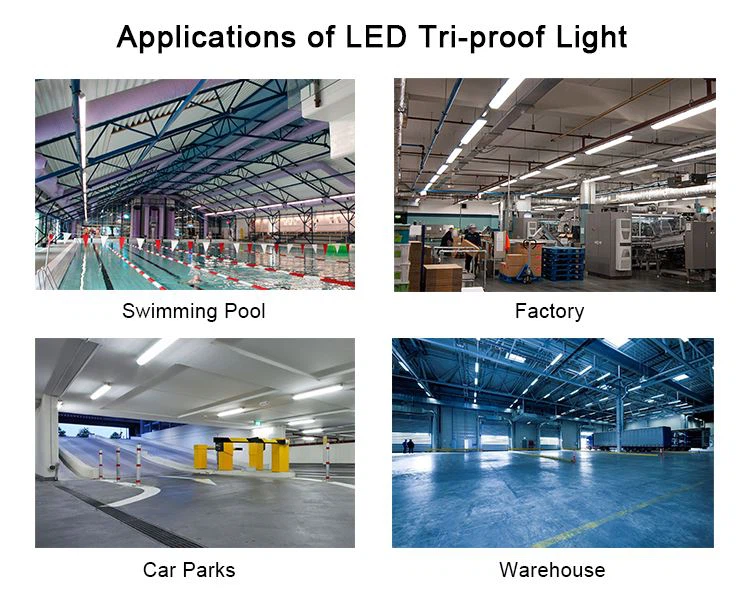
In fact, the perks that come with these LED lights are more than any other type of fixture available on the market. Tri-proof lights can be used in so many places.Moreover, their installation flexibility makes them more user-friendly and applicable. Depending on the intent or space in question, it’s easy to determine which tri-proof fixture is good for your space.
Well, there are many types of tri-proof luminaries (Parkade, Ranchers, Gaul, Alpha, and EcoMini), each with its own unique sets of features, adaptive capabilities, and perks. In fact, it’s safe to assume that some fixtures are designed for specific environments. For instance, the lighting and protection needs of a light fixture in a carwash are much higher than those in a supermarket.
Send Inquiry