


3d wall panels with led lights
Nov 05, 2025
Leave a message

How Do 3D Wall Panels with LED Lights Work?
3D wall panels with LED lights combine textured surface materials with embedded addressable LED strips that receive digital signals from a microcontroller. The LEDs illuminate the panel's dimensional features from behind or within grooves, while the controller manages color, brightness, and animation patterns through wireless protocols.
The panels themselves provide the physical structure-typically made from PVC, MDF, gypsum, or polyurethane-with channels, recesses, or translucent sections specifically designed to house LED strips. The lighting component uses individually addressable LEDs, most commonly WS2812B chips, which allow each LED to display different colors simultaneously rather than forcing the entire strip to show one color.
How 3D Wall Panels with LED Lights Are Structured
Understanding these panels requires looking at three interconnected layers that work together.
The physical panel layer creates the dimensional effect you see. Manufacturers design these panels with specific geometries-waves, hexagons, linear grooves, or organic patterns-that aren't just aesthetic choices. The depth and angle of each recess determines how light diffuses and reflects. A wave pattern with 30mm depth creates different shadow play compared to a geometric pattern with 15mm depth. The material matters too: translucent PVC allows light to pass through for a glow effect, while opaque gypsum reflects light to highlight surface texture.
The LED strip layer sits within these designed spaces. Modern addressable LED strips pack a remarkable amount of technology into a 5mm-wide flexible circuit board. Each 5050 SMD LED housing contains not just red, green, and blue light-emitting diodes, but also a tiny control chip-the WS2812B or similar IC. This chip receives data, processes its own lighting instructions, then passes remaining data down the line to the next LED. A 60-LED-per-meter strip means 60 independent processors, each making decisions about its own color and brightness in real time.
The data transmission happens through a specialized one-wire protocol. Instead of separate wires for each color channel like old RGB strips, addressable LEDs need only three connections: 5V power, ground, and a single data line. The controller sends a continuous stream of binary pulses-long pulses for "1" and short pulses for "0"-with precise timing measured in microseconds. Each LED consumes exactly 24 bits of data (8 bits per color channel), strips off its portion, then forwards the rest. This daisy-chain architecture allows hundreds of LEDs to operate from one control pin.
The control layer orchestrates everything in 3D wall panels with LED lights. At its core sits a microcontroller-usually an ESP8266 or ESP32 chip-running specialized firmware like WLED. This open-source software transforms the microcontroller into a lighting computer. It connects to your WiFi network, hosts a web interface accessible from any browser, and continuously calculates the color values for each LED based on the selected effect.
The processing demands aren't trivial. To display a simple "rainbow" effect across 300 LEDs at 60 frames per second, the controller performs 18,000 color calculations every second. More complex effects like "meteor shower" or "fire flicker" require randomization algorithms, smoothing functions, and color palette interpolation-all happening in real time on a chip smaller than your thumbnail.
Power Distribution and Voltage Management
LED wall panels face a challenge that doesn't exist with traditional lighting: voltage drop across long runs.
Each WS2812B LED consumes approximately 50-60 milliamps at full white brightness. A 5-meter strip with 300 LEDs draws up to 18 amps at peak-more current than most household circuits can safely deliver through thin LED strip traces. But the physics gets worse: as electricity flows through the copper traces, resistance causes voltage to decrease. By the time power reaches the 200th LED, what started as 5 volts might drop to 4.2 volts, causing those LEDs to appear dimmer and shift toward orange-red tones.
Professional installations solve this through power injection-connecting additional power lines at multiple points along the strip. For a large wall installation, you might inject power every 150 LEDs, ensuring voltage remains between 4.8-5.2V everywhere. The data signal doesn't suffer from voltage drop since it uses digital pulses that either register as "high" or "low," but the power needs careful management.
The power supply itself deserves consideration. These systems need regulated 5V DC supplies with sufficient amperage headroom. A common mistake is undersizing the power supply-running 300 LEDs at 60mA requires a 20-amp power supply with overhead, not the 10-amp unit that seems adequate on paper. Quality power supplies include overcurrent protection, preventing panel damage if a short circuit occurs.
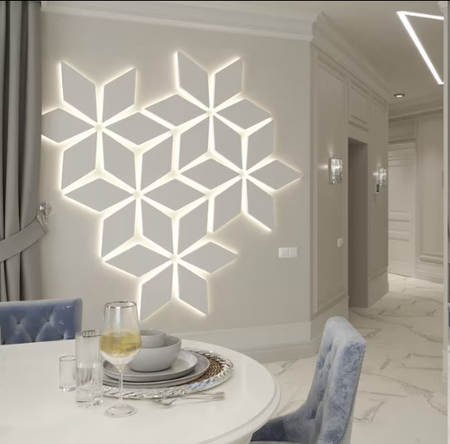
LED Integration Methods in 3D Wall Panels
How manufacturers actually integrate LEDs into panels varies significantly based on material and intended effect.
Recessed channel design is most common with rigid panels. During manufacturing, CNC machines or molding processes create continuous grooves along the back or within the panel structure. These channels measure precisely-typically 10-12mm wide-to snugly fit LED strips while allowing some airflow. The strip adheres via its built-in adhesive backing, though professional installers often supplement with aluminum channel clips that also aid heat dissipation.
Some gypsum and plaster panels use the backlighting cavity method. The panel mounts 15-30mm away from the wall on spacer clips, creating a gap. LED strips attach directly to the wall behind the panel, and light escapes through deliberate gaps between panel sections or through translucent inserts. This indirect lighting creates ambient glow without visible LED hotspots.
Diffuser integration represents a more sophisticated approach in 3D wall panels with LED lights. Translucent PVC or acrylic covers snap over LED channels, scattering light before it exits the panel. The diffusion distance-how far light travels through the diffuser-dramatically affects appearance. A 3mm diffuser creates defined glow lines; a 10mm diffuser produces soft, even illumination where individual LEDs become invisible.
MDF and wooden slat panels often employ groove insertion systems where the LED strip slides into a pre-routed channel after panel installation. This provides installation flexibility-you can add or remove lighting without replacing entire panels. The wood itself may receive a matte finish on the interior groove surface to reduce reflectivity and create more controlled light spill.
Control Protocols and Smart Integration
The intelligence behind these systems goes beyond simple on-off switching.
WLED firmware, the most popular control software for these installations, supports over 100 built-in effects. But these aren't just random color changes-they're parametric algorithms. Take the "meteor" effect: the software generates a moving bright spot with trailing fade. Parameters control meteor speed, fade rate, trail length, and whether meteors spawn randomly or at intervals. Users adjust these variables through sliders, creating virtually infinite variations from one base effect.
Color management uses the HSV model (Hue, Saturation, Value) internally rather than RGB. This matters for smooth transitions-morphing from red to blue through the HSV color wheel creates the expected purple intermediate, while RGB interpolation might produce unexpected browns. WLED performs these calculations in HSV space, then converts to RGB values before transmitting to LEDs.
The segmentation feature lets you divide a single LED strip into virtual zones. You might configure a 300-LED wall installation as three 100-LED segments, each running different effects simultaneously. The software maintains separate state information for each segment-current effect, colors, speed-while sending everything out through one data pin as a continuous stream.
Network protocols enable the impressive integration capabilities of 3D wall panels with LED lights. WLED implements several API standards: a REST API for HTTP requests, a UDP protocol for real-time synchronization between multiple panels, MQTT for smart home integration, and native support for Home Assistant, Alexa, and Google Assistant. When you ask Alexa to "set wall panel to blue," your voice command travels through Amazon's servers, converts to an HTTP request, reaches your local WLED controller, which then calculates RGB values and transmits them to the LEDs-all in under 300 milliseconds.
Real-Time Effect Generation
What happens in those microseconds between you selecting an effect and seeing it on your wall?
The controller stores effect algorithms as code functions. When you select "Rainbow Cycle," you're activating a function that calculates each LED's color based on its position and the current time. The function runs continuously in a loop-WLED's main loop executes about 100-120 times per second on an ESP32.
Each iteration, the effect function receives inputs: the number of LEDs, current timestamp, user-set parameters like speed and intensity. It outputs an array of color values-one RGB triplet per LED. A simple effect like solid color just fills the array with identical values. Complex effects perform mathematical operations.
Consider a "fire" effect: the algorithm uses Perlin noise (a specific randomization technique that produces organic-looking variation) to generate flickering values. For each LED, it samples the noise function at coordinates based on the LED position and current time, produces a value between 0-255, then maps that value to a color palette ranging from deep red through orange to yellow. The noise sampling coordinates advance slightly each frame, creating the illusion of flames dancing upward.
The rendered color array goes to a transmission function that converts RGB values into the precise timing pulses WS2812B LEDs expect. This conversion must maintain microsecond accuracy-a 1.2μs pulse for binary "1" or 0.4μs for "0", with specific high and low durations. The ESP32 can generate these pulses efficiently using its RMT (Remote Control) peripheral, which operates independently of the main processor, preventing timing jitter from WiFi interrupts or other tasks.
Installing 3D Wall Panels with LED Lights: Critical Considerations
The electrical characteristics of your installation environment directly impact system behavior.
Electromagnetic interference becomes significant with long LED runs. The data line carries rapid signal transitions that can pick up noise from nearby AC wiring, motors, or even fluorescent lights. This manifests as random pixel flickering or color corruption. Professional installations use a 330-470 ohm resistor placed between the controller's data pin and the LED strip's data input-this resistor limits current and reduces signal reflection that causes ghost triggering.
Capacitance smoothing prevents another common issue: power supply "sag" when all LEDs suddenly switch from off to full white. This current surge can momentarily drop voltage, causing the microcontroller to reset. A 1000μF capacitor across the power supply output acts as a small battery, supplying the instantaneous current demand while the power supply catches up.
Grounding strategy matters more than installers expect. LED strips, panels, controllers, and power supplies should all share a common ground reference point. Star grounding-where all grounds connect to one central point rather than daisy-chaining-prevents ground loops that introduce noise. This becomes critical in metal panel installations where the panel itself might create multiple ground paths.
Temperature management deserves attention despite LEDs' reputation for cool operation. While each LED produces minimal heat, 300 LEDs collectively dissipate 15-20 watts as heat even at moderate brightness. Behind a panel with limited airflow, temperatures can reach 50-60°C. Most LED strips tolerate this, but their adhesive backing might fail. Aluminum mounting channels improve heat spreading and provide mechanical support beyond adhesive alone.
The Evolution From Static to Interactive
Recent developments push beyond programmed light shows toward responsive systems.
Microphone integration transforms audio into visual effects in real time. A small electret microphone connects to the controller's analog input, converting sound pressure into voltage. Software samples this input thousands of times per second, performs Fast Fourier Transform (FFT) analysis to extract frequency components, then maps bass, midrange, and treble to different visual parameters. A music-reactive preset might pulse brightness with the beat, sweep colors with melody, and trigger sparkle effects on high-frequency content.
The FFT processing is mathematically intensive-converting a time-domain audio signal into frequency components requires computing complex exponentials and trigonometric functions. Yet modern ESP32 chips with hardware floating-point units perform 1024-point FFTs in under 10 milliseconds, fast enough for smooth audio visualization.
Environmental sensors enable context-aware lighting. A temperature sensor might gradually shift colors cooler as room temperature rises. An ambient light sensor could automatically adjust brightness-dim panels in a dark room, increase intensity in bright daylight. A PIR motion detector triggers specific presets when someone enters, then fades to a low power state after several minutes without movement.
These sensors connect through the controller's GPIO pins, reading digital high/low signals or analog voltages. WLED's usermod system allows custom code modules that process sensor data and modify lighting behavior without rewriting core firmware.
Troubleshooting Common System Behaviors
Certain symptoms have specific technical causes that reveal how the system works.
If only the first section of LEDs lights up, the data signal isn't propagating down the chain. This typically means a damaged LED somewhere between the controller and the dark section-each LED must successfully receive data and pass it forward. The break point is usually at the last working LED or first non-working LED. Less commonly, the issue is data voltage compatibility: WS2812B LEDs need data signals above 3.5V to register as "high," but some controllers output only 3.3V, causing unreliable operation.
Color shifting from white toward pink or orange at the end of long runs indicates voltage drop. The blue LEDs have higher forward voltage (3.2V vs 2.0V for red) and drop out first as supply voltage decreases. The solution is power injection-connecting additional 5V lines at the affected section.
Flickering, random colors, or "rainbow vomit" suggests data corruption. Possible causes include no resistor on the data line, data wire running parallel to AC wires (inducing interference), loose data connections, or running the strip beyond the controller's maximum rated LED count. Each LED adds slight capacitance and resistance to the data line; beyond 500-800 LEDs, signal integrity degrades even with perfect installation.
Panels that freeze, restart randomly, or disconnect from WiFi point to power supply problems. WiFi transmission bursts draw extra current-if the power supply can't deliver or voltage sags, the controller's brownout detector triggers a reset. This is especially common with undersized 5V USB adapters rated 2-3A when the system really needs 5-10A for the LEDs plus 500mA for the controller.
Advanced Configuration Capabilities
Once basic operation is mastered, the system reveals deeper customization layers.
Preset cycling creates dynamic lighting that changes throughout the day without manual intervention. You might program morning presets with cool, energizing blues that gradually warm to neutral white for daytime, then shift to warm amber for evening, finally dimming to deep red for night. The playlist feature cycles through these presets automatically, with configurable transition times and durations.
Synchronization between multiple panels maintains coherence in large installations. WLED's UDP protocol broadcasts each controller's current state across your local network. Other controllers receive these broadcasts and mirror the effect-not by receiving color data for each LED, but by executing the same effect algorithm with synchronized timing. This keeps network traffic minimal while maintaining perfect synchronization even with hundreds of 3D wall panels with LED lights.
Segment mirroring lets you configure symmetrical patterns effortlessly. Define the right half of your panel as a mirror of the left half, and the software automatically duplicates pixels in reverse order. Complex geometric patterns become simple to program once you understand the indexing system-which LED is number 0, which way the strip winds through the panel, and how segment boundaries map to physical locations.
API integration opens programmatic control. A home automation system could adjust lighting based on calendar events, weather forecasts, or security camera triggers. You might dim panels automatically when your TV turns on, pulse red when a sensor detects water leakage, or flash green when your smart doorbell rings. The REST API accepts simple HTTP commands, making integration accessible even for non-programmers using tools like IFTTT or Node-RED.
Material Science Behind Light Diffusion
The physics of how light travels through and reflects off materials determines the final visual effect.
Translucent PVC panels scatter light through bulk scattering-photons penetrate the material, encounter microscopic internal structures, and redirect in random directions. The scattering coefficient depends on material thickness, additives, and surface treatment. A 3mm panel with high scattering creates diffuse glow with no visible hotspots; a 1mm panel with low scattering shows distinct LED positions as bright points.
Matte white surfaces have high reflectance (80-90%) across the visible spectrum, making them ideal for indirect lighting channels. Light bounces multiple times within a groove before exiting, mixing colors thoroughly. This is why RGB LEDs can produce white when reflecting off matte surfaces-the multiple bounces blend the discrete red, green, and blue sources into perceived white.
Specular reflective surfaces like polished metal or glossy paint create directed reflections rather than diffuse scatter. A strip in a chrome channel produces light stripes-each LED reflects as a distinct bright spot. Some designs exploit this: a brushed metal panel with an LED strip at the top edge creates dramatic downward washes of light, with the brush pattern creating subtle texture in the reflection.
The inverse square law affects perceived brightness: light intensity drops with the square of distance from the source. An LED 10mm behind a diffuser appears 4× dimmer than the same LED 5mm away. Panel designers account for this-deeper recesses need higher LED density or brighter LEDs to maintain even illumination.
Power Efficiency and Operating Economics
The electrical costs and efficiency metrics matter for always-on installations.
At 50mA per LED, a 300-LED panel draws 15 watts when displaying full-brightness white (all three color channels at maximum). But typical usage rarely hits this peak. A blue-cyan effect might average 10 watts; a dim amber nightlight might draw 3 watts. WLED includes configurable current limiting that prevents exceeding a specified total wattage, protecting both your power supply and electricity bill.
Calculated across typical usage patterns-perhaps 8 hours per day at 50% average brightness-a 300-LED panel consumes about 15-20 kWh per month. At $0.12/kWh electricity rates, that's $1.80-2.40 monthly operating cost. Comparable accent lighting using incandescent or even LED bulbs often costs more while providing less customizable illumination.
The efficiency advantage comes from addressable control. Traditional RGB strips must show the same color across their entire length; achieving multicolor effects requires multiple separate strips and complex wiring. Addressable panels achieve hundreds of unique colors simultaneously through software, no additional hardware needed. This reduces total LED count, power consumption, and installation complexity while expanding creative possibilities.
Sleep modes and brightness curves further optimize efficiency. Panels can automatically dim during late night hours when no one's watching, or shut down completely based on occupancy sensors. The power relay feature in some controllers physically disconnects LED power when idle, eliminating even the standby current draw of powered-but-dark LEDs.
Frequently Asked Questions
Can you use regular LED strips in 3D panels?
Non-addressable LED strips-the type where the entire strip changes color together-work with 3D panels but severely limit effects. You get single-color accent lighting rather than flowing animations, color gradients, or reactive patterns. Addressable strips like WS2812B cost only slightly more but unlock the technology's full potential. The controller and power supply requirements remain the same, so it's worth choosing addressable strips from the start rather than upgrading later.
How do you prevent the LEDs from overheating inside the panel?
LED thermal management relies on several factors working together. First, don't run panels at full brightness continuously-most aesthetic effects use 30-50% brightness, which generates manageable heat. Second, ensure some airflow behind panels using spacers or channels rather than sealing LEDs against solid walls. Third, aluminum LED channels provide heatsinking through the entire strip length. Finally, quality LED strips use thick copper traces and effective bonding between LED and PCB, improving heat transfer. Temperatures reaching 50-60°C are normal and won't damage most strips.
What's the maximum length of LED strip you can control?
The practical limit isn't strip length but LED count and data signal integrity. A single data pin on a microcontroller can theoretically control unlimited LEDs, but signal degradation becomes problematic beyond 500-800 individual LEDs on one continuous strip. The solution is either multiple shorter runs each with their own data pin (WLED supports multiple outputs), or data signal amplifiers every 300-400 LEDs that regenerate the digital signal. Power injection every 150-200 LEDs prevents voltage drop regardless of total installation size.
Do these panels work with voice assistants like Alexa?
WLED firmware includes native integration with Amazon Alexa, Google Assistant, and Apple HomeKit. After initial setup through the WLED web interface, you discover the panel as a smart light device in your assistant's app. Voice commands control power, brightness, and colors: "Alexa, set wall panel to 50% brightness" or "Hey Google, turn the panel blue." Effect selection through voice works through preset names you define: "Alexa, activate Rainbow mode" if you named a preset "Rainbow." Most modern 3D wall panels with LED lights support these voice control features out of the box, making them convenient additions to any smart home ecosystem.
Send Inquiry