


Which led tube light is best for home
Aug 22, 2025
Leave a message
If you wonder which led tube light is best for home, you are not alone. Today, almost half of US households use LED lighting as their main choice, with LED options growing from just 4% to 47% in five years. People like LED tube lights because they save energy, last longer, and give you the right brightness for every room. You should think about your room size, how much light you want, and what color temperature feels most comfortable.
Which LED Tube Light is Best for Home
Top Brands
- When you want to know which led tube light is best for home, you should start by looking at the most trusted brands. These brands have built a strong reputation for quality, energy savings, and user satisfaction. Many homeowners choose them because they offer reliable performance and advanced features.
- Some brands focus on energy efficiency and smart technology. You can find options that let you control the lights with your voice or phone. These brands often lead the market with new ideas and sustainable designs.
- Other brands stand out for their high brightness and color quality. You get clear, comfortable light that makes your home feel welcoming.
- Some companies offer a wide range of tube lights, from basic models to smart, dimmable options. This gives you more choices to match your needs.
- Customer reviews often mention easy installation, good customer service, and long-lasting products as reasons to trust these brands.
Tip: When you shop for LED tube lights, check for brands that offer a good warranty and helpful support. This can save you trouble if you ever need help with your lights.
Best Models
You might still wonder which led tube light is best for home when you see so many models on the market. The answer depends on your room size, lighting needs, and how you want your space to feel. Here are some of the most popular and highly rated types:
- T5 LED tube lights are very popular in homes. They make up over half of the residential market because they are slim, easy to fit, and use less energy.
- T8 LED tube lights are also a top choice. They work well in older fixtures and give you a good balance of brightness and efficiency. Many people pick T8 tubes when they want to upgrade from old fluorescent lights.
- Smart LED tube lights are becoming more common. You can adjust the brightness or color with your phone or voice. These models are great if you want more control over your home lighting.
- Universal Type A+B tubes are flexible. You can use them with or without the old ballast, making installation simple.
Here is a quick look at some common types and their best uses:
|
Model Type |
Wattage |
Length |
Color Temperature |
Best For |
Notes |
|---|---|---|---|---|---|
|
T5 LED Tube |
10-14W |
2-4ft |
2700K-6500K |
Bedrooms, kitchens, hallways |
Slim design, energy-saving |
|
T8 LED Tube |
18-24W |
2-4ft |
2700K-6500K |
Living rooms, garages, offices |
Fits most fixtures, easy to retrofit |
|
Decorative/Pendant Tube |
Varies |
Varies |
2700K-3000K |
Living rooms, dining areas |
Warm, cozy light, stylish look |
|
Smart/Dimmable Tube |
Varies |
Varies |
Adjustable |
Any room needing flexible light |
App or voice control, mood lighting |
You might notice that many people like 4-foot LED tube lights. These models get good reviews for being affordable, bright, and easy to install. Some users say they wish the lights lasted longer, so look for models with a strong warranty.
Lighting experts often suggest using warm white tubes (2700K-3000K) in living spaces to create a cozy feel. For kitchens or work areas, cool white (5000K-6500K) works best because it helps you see details clearly.
If you still ask which led tube light is best for home, remember that T8 tubes are the most common and versatile. They fit most home fixtures and give you a good mix of brightness and energy savings. Smart and dimmable models add extra comfort and control, making them a great choice for modern homes.
LED vs. CFL Tube Lights
Efficiency
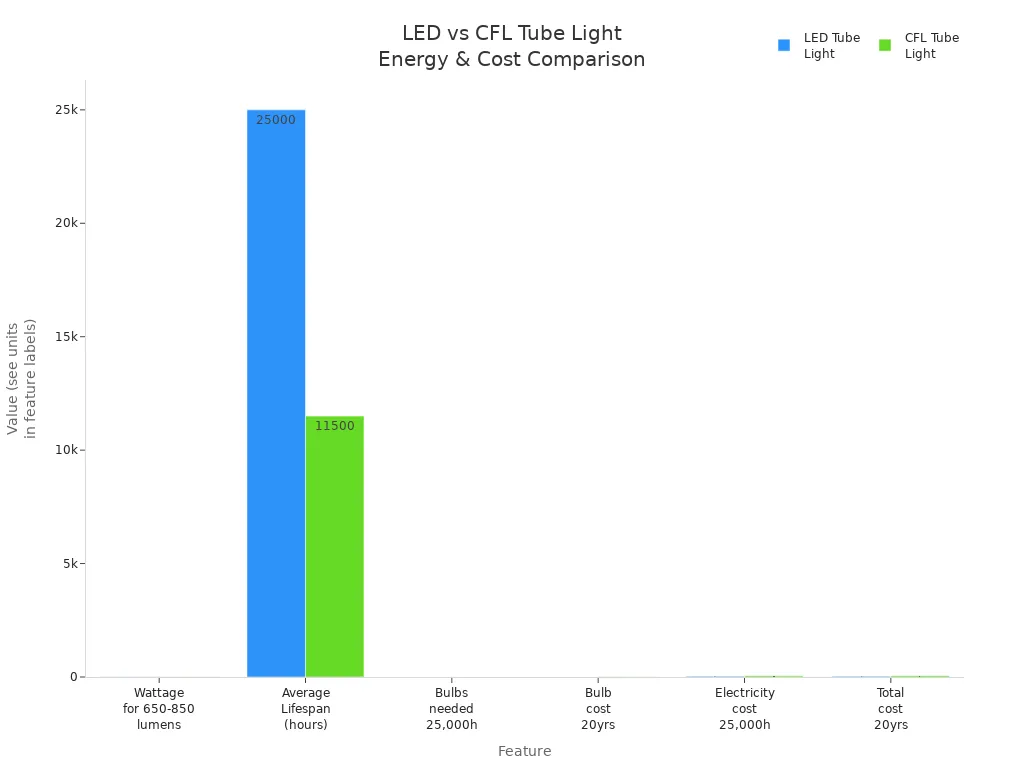
When you compare LED tube lights to CFL tube lights, you notice a big difference in energy efficiency. LEDs use less power because they turn more electricity into light instead of heat. For example, an 18W LED tube light can replace a 36W fluorescent tube and still give you the same brightness. That means you save money every month on your electricity bill. Over time, these savings really add up.
Here's a quick look at how LEDs and CFLs stack up:
|
Feature |
LED Tube Light |
CFL Tube Light |
|---|---|---|
|
Wattage for ~650-850 lumens |
7-10W |
13-18W |
|
Average Lifespan |
~25,000 hours |
8,000 to 15,000 hours |
|
Bulbs needed for 25,000 hours |
1 |
3 |
|
Total bulb purchase cost over 20 years |
~$4 |
~$6 |
|
Electricity cost for 25,000 hours (@ $0.15/kWh) |
~$30 |
~$52 |
|
Total estimated cost over 20 years |
~$34 |
~$54 |
Tip: LEDs also produce less heat, which can help keep your home cooler in the summer.
Lifespan
You want your lights to last as long as possible. LED tube lights usually last much longer than CFL tube lights. Most LEDs can shine for about 25,000 hours or more, while CFLs often last between 8,000 and 15,000 hours. That means you will change LED bulbs less often, saving you time and hassle.
|
Light Type |
Average Lifespan (hours) |
|---|---|
|
LED |
Approximately 25,000 |
|
CFL |
Approximately 8,000 |
Some LEDs may last even longer if you choose a high-quality brand. CFLs tend to lose brightness over time, so you might notice your room getting dimmer before the bulb actually burns out.
Light Quality
LED tube lights give you better light quality for your home. They have a higher Color Rendering Index (CRI), often above 90, so colors look more natural and vivid. You get instant full brightness with LEDs, and many models let you adjust the color temperature or dim the lights for comfort.
- LEDs turn on right away and do not flicker, which helps prevent headaches and eye strain.
- CFL tube lights can take a while to reach full brightness and sometimes flicker, which can be annoying.
- LEDs come in warm white (2700K-3000K) for cozy spaces like bedrooms, and cool white (3500K-5000K) for kitchens and bathrooms.
- CFLs contain mercury and emit some UV light, which is not ideal for home comfort or safety.
If you want the best mix of energy efficiency, long life, and comfortable light, LED tube lights are the clear winner for home use.
Key Factors to Consider
Wattage
Pick an LED tube light that fits your room size. Experts say use 10 to 15 watts for each square meter. If your room is 4 by 5 meters, you need 40 to 75 watts total. Small bedrooms or hallways do well with 18-20W tubes. Big living rooms or work areas might need up to 60W. Think about how you use the room. More watts give you more light, but you should not waste energy.
Brightness
How bright your light is really matters. LED tube lights show brightness in lumens, not watts. LEDs give you more light using less power. For example, a 15-20W LED tube gives 2,350 to 2,800 lumens. This is as bright or brighter than a 32-40W fluorescent tube. Most LED tubes give 100 to 160 lumens for each watt. This means you save money and still have a bright home.
|
Wattage (LED) |
Lumens Output |
Equivalent Fluorescent Wattage |
Notes |
|---|---|---|---|
|
15-20 W |
2,350 - 2,800 |
32-40 W |
LED gives same or more light with about half the power |
|
18 W |
~2,800 |
36 W |
LED can replace fluorescent and be just as bright or brighter |
Color Temperature
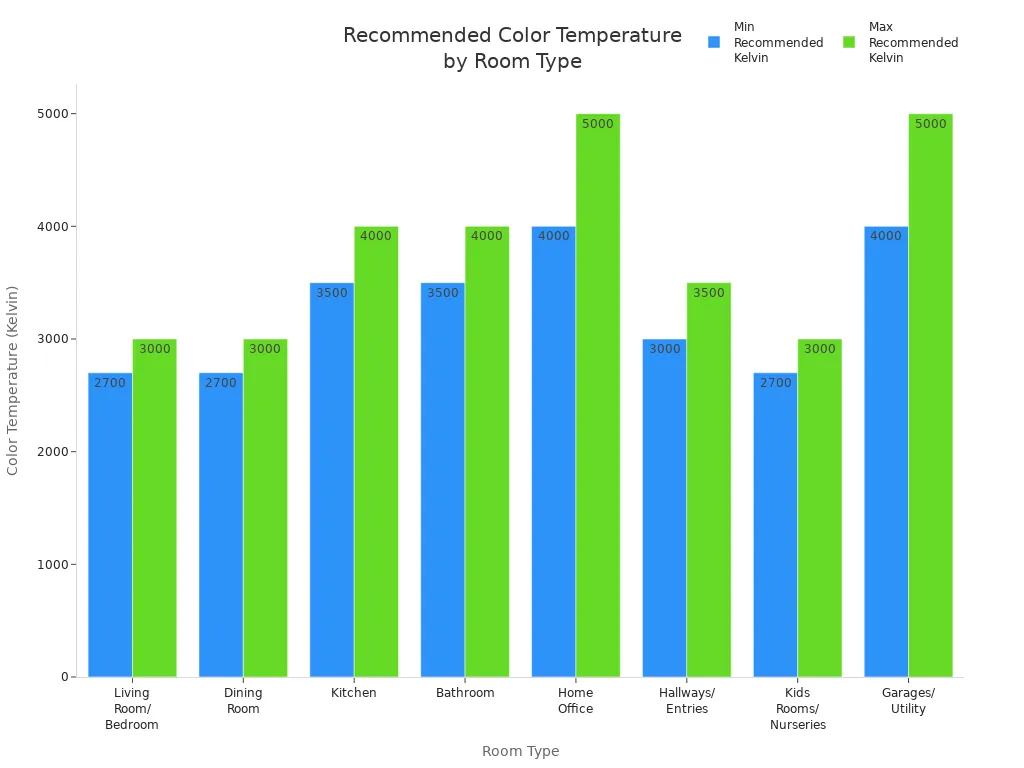
Color temperature changes how a room feels. Warm white (2700K-3000K) makes bedrooms and living rooms feel cozy. Kitchens and bathrooms need cooler light, around 3500K-4000K, so you can see better. Home offices and garages work best with 4000K-5000K for focus and detail. Experts suggest different color temperatures for each room:
Compatibility
Check if your fixture works with the LED tube light before buying. Some tubes work with old ballasts, but others need new wiring. Using the wrong tube can make the light not work right. Look at the socket type too-T8 fixtures usually have shunted sockets, and T12 have non-shunted ones. Safety is important, so follow electrical rules. If you want smart controls or dimming, get tubes made for those features.
- LED tubes come as direct wire, ballast compatible, hybrid, and universal.
- Tube size must fit your fixture: T8 is 1 inch, T12 is 1.5 inches, T5 is 5/8 inch.
- Direct wire tubes need non-shunted sockets and may need an electrician.
Lens Type
Frosted lens LED tube lights make your home feel nicer. They spread light evenly and stop glare, which helps your eyes. You get softer shadows and a cozy feeling. Frosted lenses hide the LED parts, so you do not see bright spots. They give a little less light than clear lenses, but the comfort is worth it.
- Frosted lenses give soft, even light.
- They help your eyes and stop harsh shadows.
- The cover hides bright LED chips, so the light is easier to look at.
Tube Size: T5, T8, T12
Tube size changes how much energy you use, how bright the light is, and the price. T8 tubes are most popular for homes because they balance these things well. T5 tubes are thinner and save more energy but cost more. T12 tubes are older, use more power, and are not used much anymore.
|
Attribute |
T5 LED Tubes |
T8 LED Tubes |
T12 LED Tubes |
|---|---|---|---|
|
Diameter |
5/8 inch |
1 inch |
1.5 inches |
|
Energy Efficiency |
Most efficient |
Moderately efficient |
Least efficient |
|
Brightness |
Brightest |
Moderate brightness |
Least bright |
|
Cost |
Most expensive |
Moderate cost |
Least expensive |
|
Common Use |
Accent lighting, cabinets |
General lighting in homes |
Older installations |
T8 LED tube lights work best for most homes. They fit many fixtures, save energy, and give good light for your rooms.
Room-by-Room Guide
Living Room
You want your living room to feel cozy and welcoming. Warm white LED tube lights with a color temperature between 2700K and 3000K work best here. These lights create a relaxing mood and make your space inviting. You can use dimmable LED tube lights to adjust brightness for movie nights or gatherings. Smart LED options let you control the light with your phone or voice, so you can set the perfect ambiance anytime.
- 2700K: Warm, yellowish glow for comfort
- 3000K: Slightly warmer white, versatile for living spaces
- Dimmable and smart controls for flexible lighting
Tip: Choose LED tube lights with high CRI for vibrant colors and EyeComfort technology to reduce glare.
Kitchen
In the kitchen, you need bright, clear light for cooking and cleaning. Neutral white LED tube lights around 3500K give you the best visibility. Look for models with high energy efficiency and a CRI above 80 to see food colors accurately. For task areas, aim for 300-500 lumens per linear foot. Dimmable and smart LED tube lights help you adjust the light for different activities.
- 3500K: Neutral white for clarity
- 300-500 lumens per foot for task lighting
- High CRI for accurate color
Bedroom
Your bedroom should feel peaceful and restful. Warm white LED tube lights (2700K-3000K) create a soft glow that helps you relax. Dimmable LED tube lights let you set the brightness for reading or winding down. Smart LED options make it easy to change the mood with your phone or voice.
- 2700K-3000K: Warm white for relaxation
- Dimmable features for comfort
- Smart controls for easy adjustment
Bathroom
Safety matters most in the bathroom. Use LED tube lights rated for damp or wet locations. Neutral white (3500K) works well above sinks and mirrors. For showers or tubs, pick wet-rated LEDs with IP66 or higher. Always check for UL or ETL certifications to avoid hazards.
|
Area |
Recommended LED Type |
Color Temp |
Safety Rating |
|---|---|---|---|
|
Above sink/mirror |
Damp-rated |
3500K |
UL/ETL, IP44+ |
|
Shower/tub area |
Wet-rated |
3500K |
UL/ETL, IP66+ |
Note: Turn off power before installation and follow manufacturer instructions for safety.
Other Spaces
For hallways, garages, or utility rooms, use cool white LED tube lights (4000K-5000K) for clear visibility. T8 LED tube lights fit most fixtures and offer great energy efficiency. In workspaces, choose higher wattage and brightness for better focus.
- 4000K-5000K: Cool white for clarity
- T8 tubes for easy installation
- Higher wattage for large areas
LED tube lights make every room brighter, safer, and more comfortable. You can match color temperature and features to each space for the best results.
How to Choose
Assess Needs
Before you buy an LED tube light, take a moment to think about what you really need. Here's a simple way to figure it out:
Look at the size and purpose of your space. Do you want bright light for a workspace or softer light for a living area?
Decide how bright you want the room. Check the lumens needed for each area. For example, kitchens and workspaces need more lumens than bedrooms.
Pick a color temperature that matches the mood you want. Cooler tones (4000K-6500K) help you focus, while warmer tones (2700K-3000K) make rooms feel cozy.
Think about the layout. If you have shelves or partitions, you might need more than one tube to avoid shadows and get even light.
Tip: Matching the tube size, wattage, and color temperature to your needs helps you get the best energy efficiency and comfort.
Read Labels
When you shop for LED tube lights, always check the packaging. The label gives you key details:
Luminous Flux (lumens): Shows how bright the light will be.
Color Rendering Index (CRI): Look for a CRI of 80 or higher for true-to-life colors.
Correlated Color Temperature (CCT): Tells you if the light is warm or cool.
Fixture Compatibility: Make sure the tube fits your fixture and matches the tombstone type.
UL Type A Compatibility: Lets you use the tube with your existing ballast, making installation easier.
Warranty Terms: A good warranty means the brand stands behind its product.
Note: Reading the label helps you avoid surprises and ensures you get a tube that works for your home.
Where to Buy
You want to buy from a trusted source. ShineLong LED is one brand known for quality and customer service. They use advanced technology and offer energy-efficient, eco-friendly LED tube lights that last up to 100,000 hours. You can also find reliable options at major retailers and online platforms. Always check the warranty-most top brands offer a five-year limited warranty covering defects in materials and workmanship. Some even provide up to seven years for certain models.
|
Warranty Aspect |
Details |
|---|---|
|
Duration |
5 years (some up to 7 years) |
|
Coverage |
Defects in material and workmanship; replacement parts provided |
|
Exclusions |
Labor, shipping, improper installation, electrical surges |
|
Claim Requirements |
May need photos or inspection |
Buying from a reputable retailer and checking the warranty gives you peace of mind and protects your investment in home lighting.
If you still wonder which led tube light is best for home, look at the benefits. LED tube lights save you money, last much longer, and give you better light than old fluorescent tubes. Check out this quick comparison:
|
Feature |
LED Tube Lights |
Fluorescent Tubes |
|---|---|---|
|
Energy Savings |
High |
Low |
|
Lifespan |
50,000+ hours |
1,200–6,000 hours |
|
Light Quality |
Instant, no flicker |
Flickers, warms up |
|
Eco-Friendly |
Yes |
Contains mercury |
You can review your current lighting and upgrade room by room. Use the guide above to pick the right tube for each space and enjoy a brighter, more comfortable home.
Send Inquiry