


Solar Panel For LED Lights
Sep 26, 2025
Leave a message
Solar Panel for LED Lights: How to Choose the Right Power Source for Outdoor Projects
To pick the best Solar Panel for LED Lights outside, you start by looking at how much light you need. Next, you figure out the size of the solar panel and battery. You also check how well the panel works and how strong it is. Then, you plan where to put it. This helps you save energy and makes sure your lights work well. It also means you do not have to fix them often. Solar lighting uses energy that comes from the sun. This helps you make less pollution. If you match the panel size to the LED lights, they work their best. This helps you reach your green goals and saves money over time.

Key Takeaways
- Figure out how much power your LED lights need. Add up the wattage and how long you use them. This helps you pick the right solar panel system for your energy needs.
- Pick a solar panel size that matches how much sun you get. If your area is shady, you need bigger panels to work well.
- Choose good solar panels, like monocrystalline ones. These work better and last longer. They also save energy and need less fixing.
- Take care of your solar panel system often. Clean the panels and look at the connections. Doing this helps your system work better and last longer.
- Use a charge controller to keep your battery safe. It stops the battery from getting too full or too empty. This makes your battery last longer and saves money on new ones.
Assessing LED Lighting Needs

LED Wattage and Runtime
When you plan lights outside, you need to know how much power your LED lights use. The wattage and how long you want the lights on will decide the size of your Solar Panel for LED Lights system. If you work for a telecom company or build big projects, you must do the math right. This stops your lights from being too weak and helps you avoid fixing them a lot.
Tip: Always look at the datasheet from the maker to find out the LED wattage and how many hours they should run.
- Think about these things when you add up the total wattage for your outdoor LED lights:
- Area Size and Coverage: Big places like towers or parking lots need more wattage to be bright enough.
- Desired Brightness and Lumen Output: Pick the wattage based on how bright you want it for safety.
- Energy Efficiency and Cost: Choose LEDs that use less power but still work well to save money.
- Temperature and Environment: In hot places, LEDs with lower wattage can last longer and work better.
- Durability and Longevity: LEDs with less wattage make less heat, so they can last more years.
How long your LED lights stay on depends on the battery size. A bigger battery can hold more energy. This means your lights can work longer, even if it is cloudy. This is very important if you need lights all night or all the time, like at far-away telecom sites.
|
Application Scenario |
Typical LED Wattage |
Recommended Runtime |
Notes |
|---|---|---|---|
|
Telecom Tower |
30W-60W |
10-12 hours/night |
High reliability needed |
|
EPC Construction |
20W-40W |
8-10 hours/night |
Focus on safety lighting |
|
Distributor Demo |
10W-20W |
6-8 hours/night |
Emphasize cost savings |
Sunlight and Location
Where you put your Solar Panel for LED Lights system matters a lot. You need to check how much sun your site gets and what the weather is like. If you get lots of sun, you can use smaller panels. If you have clouds or shade, you need bigger panels and batteries.
Note: Use solar maps or weather data to guess how many sunlight hours your project will get each day.
If your lights are in the north or in a city with lots of shade, you need to make your panel bigger. This helps make up for less sunlight. If you buy for a business, you must plan for changes in seasons. This makes sure your lights work all year. Checking sunlight and location well helps you get more value and keeps your lights working longer.
Solar Panel for LED Lights: Sizing and Calculation

Choosing the right Solar Panel for LED Lights means you must size your system carefully. You want your outdoor lighting to work reliably, even in tough weather. If you work for a telecom company, EPC contractor, or distributor, you need a system that delivers strong ROI and reduces maintenance risks. Follow these steps to size your solar panel and battery for outdoor LED projects.
Sizing Steps
You can use a proven method to size your Solar Panel for LED Lights system. This process helps you match your panel and battery to your lighting needs.
Determine Your Load
Find the total wattage of all LED fixtures. Multiply by the number of hours you want the lights to run each night.
Example: 40W LED × 10 hours = 400 watt-hours per night.
Calculate Daily Amps
Divide the total watt-hours by the system voltage (usually 12V or 24V).
Example: 400Wh ÷ 12V = 33.3 amp-hours per day.
Multiply for Multiple Fixtures
If you use more than one fixture, multiply the amp-hours by the number of fixtures.
Add for Solar Degradation
Increase your total by 20% to account for panel aging and dirt.
Example: 33.3Ah × 1.2 = 40Ah.
Check Available Sun Hours
Use solar maps or weather data to find the lowest average sun hours for your location, especially in winter.
Example: 4 sun hours per day.
Calculate Panel Size
Divide the total amp-hours by the sun hours to get the minimum panel output needed.
Example: 40Ah ÷ 4h = 10A. For a 12V system, 10A × 12V = 120W panel.
Tip: Always use the array-to-load ratio (ALR) to check if your panel wattage exceeds your lighting load. This ensures your system works even on cloudy days.
Seasonal Adjustments:
Seasonal changes, such as winter snow or cloudy days, can lower panel efficiency. You should choose larger batteries or backup power for areas with harsh weather. Adjust your expectations for illumination duration based on daylight hours.
Calculation Example
Here is a real-world example for sizing a Solar Panel for LED Lights system for a telecom tower:
|
Step |
Description |
|---|---|
|
Load Estimation |
2 × 30W LED fixtures × 12 hours/night = 720Wh/day. Multiply by 1.3 for energy loss = 936Wh. |
|
Solar Panel Amperage |
936Wh ÷ 12V = 78Ah/day. Divide by 4 sun hours = 19.5A. Add 20% for safety = 23.4A. |
|
Panel Sizing |
23.4A × 12V = 280.8W. Choose a 300W panel for reliability. |
|
Backup Battery Sizing |
78Ah × 5 nights = 390Ah. Select a deep-cycle battery rated for at least 400Ah. |
Note: Always test your solar panel output with a multimeter before installation. This confirms the panel delivers the rated voltage and current.
Industry Standards:
Follow IEC 61215 for panel reliability and IEEE 1562 for sizing off-grid solar systems. These standards help you select quality components and ensure long-term performance.
ROI and Reliability:
Proper sizing reduces maintenance and replacement costs. You get reliable lighting, lower energy bills, and fewer site visits. This boosts your ROI and keeps your outdoor projects running smoothly.
Key Features and Selection Criteria
Panel Type and Efficiency
Picking the right panel type changes how well your lights work. It also affects how much you spend. There are three main types you can pick from:
Monocrystalline Panels: These give the most power and last the longest. They make more energy in a small space. They work well if you do not get much sun. They also do better when it is cloudy.
Polycrystalline Panels: These cost less money but are not as strong. They are good if you care more about saving money than getting the most power.
Thin-Film Panels: These are light and bend easily. You can use them for special shapes or if you want them to look nice. They do not make as much energy.
|
Panel Type |
Efficiency |
Lifespan |
Cost |
Best Use Case |
|---|---|---|---|---|
|
Monocrystalline |
High |
25+ years |
Higher |
Limited space, low-light areas |
|
Polycrystalline |
Medium |
20-25 years |
Moderate |
Budget projects |
|
Thin-Film |
Low |
10-15 years |
Lower |
Flexible, aesthetic installs |
Panels that work better help you save more energy. This means your battery lasts longer and your lights shine brighter. Your lights will work well, even if it is cloudy outside.
Tip: If you work on telecom or EPC jobs, pick monocrystalline panels. They help you save money and fix things less often.
Weather Resistance
Outdoor solar panels must handle tough weather. You need panels made from strong stuff. Look for frames made of stainless steel, aluminum, or hard plastic. An IP65 rating or higher keeps out dust and water. IK10 means your panel can take hard hits.
|
Feature |
Description |
|---|---|
|
High-efficiency solar panels |
Monocrystalline panels generate more power under low sunlight. |
|
Durable materials |
Stainless steel, aluminum, or tough plastic ensure long life. |
|
IP rating |
IP65 minimum; IP68 or IP69 for best dust and water resistance. |
|
Impact protection |
IK10 rating withstands heavy impacts. |
Certifications are important for safety and trust. Pick panels with UL, FCC, CE, ETL, CSA, or RoHS marks.
Mounting Options
You need to choose mounts that fit your area. Adjustable mounts let you move the panel to catch more sun. Fixed mounts are good for easy setups. For garden lights, use low-voltage systems to stay safe. If your LEDs need a different voltage, use a transformer so they do not break.
Note: Always make sure your Solar Panel for LED Lights system follows local rules. This keeps your project safe and helps it last longer.
Battery and Controller Essentials

Battery Sizing
You need the right battery size for your Solar Panel for LED Lights system to work all night. First, figure out how much energy your LED lights use. Multiply each light's wattage by how many hours you want them on. Add 20% more for safety. Also, think about a 10-15% loss from changing energy. This way, your battery will last all night and be more reliable.
Tip: Pick a battery with extra power. This helps if it is cloudy or you need the lights on longer.
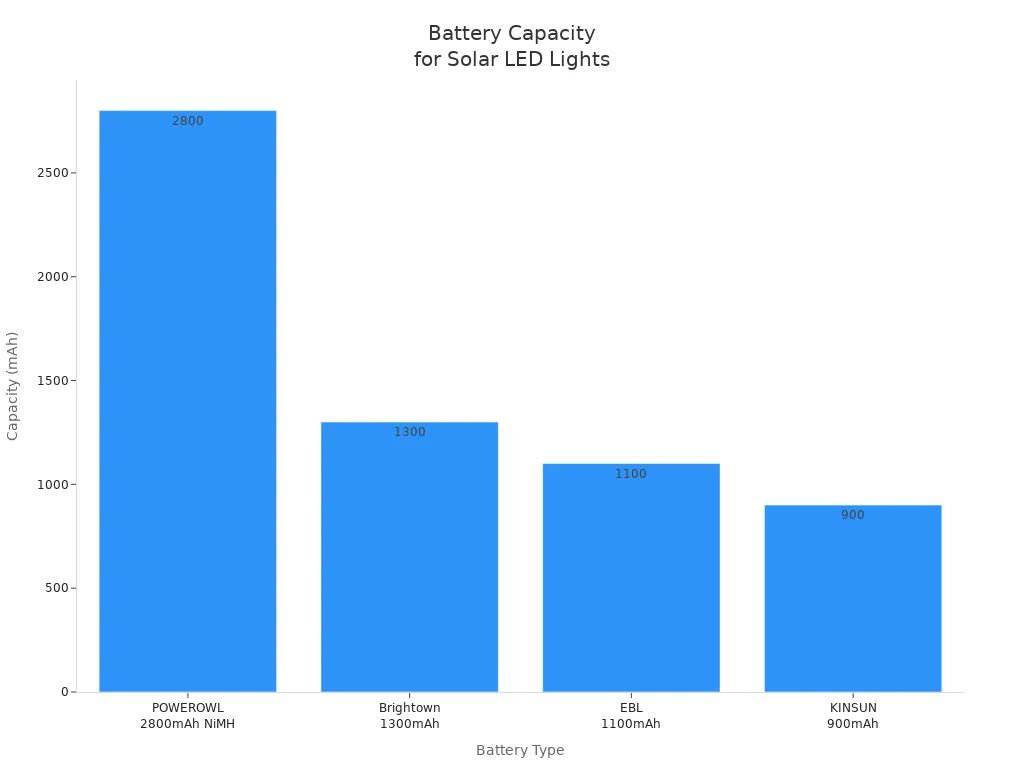
The battery type changes how often you must replace it. It also affects how much work you need to do. Here is a table that compares popular batteries for outdoor solar-powered LED lighting systems:
|
Battery Type |
Capacity |
Key Features |
Ideal Use Cases |
|---|---|---|---|
|
POWEROWL 2800mAh NiMH |
2800mAh |
High capacity, eco-friendly, 3-year warranty, resists over-discharge |
Solar yard lights, pathway markers |
|
Tenergy LiFePO4 |
N/A |
Budget-friendly, 1,000+ charge cycles, withstands harsh weather |
Outdoor solar lights |
|
Brightown 1300mAh |
1300mAh |
Compact, reliable, enough runtime for low-drain fixtures |
Garden lights |
|
EBL 1100mAh |
1100mAh |
Lightweight, portable, stores energy well |
Quick replacements |
|
KINSUN 900mAh |
900mAh |
Cheap, strong, good for simple setups |
Pathway markers, accent lights |
Lithium-ion batteries store lots of energy and last a long time.
Nickel-Metal Hydride (NiMH) batteries are good for devices that use more power and are better for the planet.
Lead-acid batteries cost less but are heavier and need more care.
Many solar lights have batteries built in. These usually give enough power for one night. This makes them easy to set up and means you do not have to fix them much.
Charge Controllers
Charge controllers keep your battery safe and help it last longer. You need a controller that fits your battery and system size. The controller stops the battery from getting too full. It also keeps the battery from losing too much power. It uses different charging steps to keep batteries healthy.
|
Function |
Description |
Impact on Battery Longevity |
|---|---|---|
|
Preventing Overcharge |
Stops charging when the battery is full. |
Keeps battery healthy. |
|
Preventing Deep Discharge |
Turns off power if battery gets too low. |
Makes battery last longer. |
|
Multi-Stage Charging |
Uses steps to fill the battery the best way. |
Helps battery work better and last longer. |
|
Battery Type Settings |
Changes charging for different battery types. |
Makes sure charging is right. |
|
Temperature Compensation |
Changes charging if it is hot or cold. |
Protects battery in all weather. |
There are two main types of controllers you can pick:
Pulse Width Modulation (PWM) controllers are good for small systems and cost less.
Maximum Power Point Tracking (MPPT) controllers are better for big systems and collect more energy.
Note: A good charge controller means less fixing, lower costs, and better value for your Solar Panel for LED Lights project.
Installation and Maintenance Tips
Installation Best Practices
If you install your solar panel for LED lights the right way, you get more energy. Your system will last longer. Good installation helps your panels work well. It also stops you from paying for repairs. Here is why these steps are important:
Maximize Sunlight Exposure: Put your solar panels where they get sun for 6–8 hours. This helps them make more energy. Your lights will stay bright all night.
Avoid Shadows: Do not put panels near trees or buildings that make shade. Even a little shade can lower how much energy you get. This means you do not save as much money.
Correct Orientation: Point the panel the right way for where you live. This helps you catch the most sunlight.
Strategic Placement: Make sure the pole or mount does not block the panel. Cut tree branches so they do not make new shadows.
Secure Mounting: Use strong mounts that can handle bad weather. This keeps your panels safe from wind and rain.
Wiring and Safety: Use wires that can handle sun and weather. Keep wires above ground so they do not touch water or snow. Ground your system to stop shocks and keep it safe.
Tip: If you put your panels in a good spot and use safe wiring, you will not have to fix them as much. Your outdoor lights will work better and last longer.
Maintenance and Troubleshooting
Taking care of your solar panel for LED lights helps them work their best. You do not want your lights to stop working by surprise. If you check your system often, it will last longer. Here is why regular care is smart:
- Clean Panels Regularly: Dirt, leaves, or snow can block the sun. Clean your panels so they make more energy.
- Inspect Connections: Look at all wires and plugs for damage. Fix problems early so they do not get worse.
- Monitor Battery Health: Check for leaks or rust on batteries. Change batteries every five to seven years for good lighting.
- Check Fixtures and Sensors: Make sure the LED lights and sensors work right. Change broken parts to keep your system strong.
It is very important to check your lights often. Clean and line up the lights, check the seals, and make sure water cannot get inside.
If your lights stop working, try these steps:
- Take off anything covering the solar panel.
- Make sure the panel gets enough sun each day.
- Check and change the batteries if needed.
- Look at all wires for damage.
- Test the bulbs and sockets.
- Turn the system off and on to reset it.
- Make sure the switch is in the right spot.
- Check the light sensor for dirt or damage.
If you do these things, you will have fewer problems. Your solar panel for LED lights will last longer. You will save money and get good value for your outdoor lights.
Picking the right solar panel for LED lights outside needs good planning. First, think about how much light you need. Then, choose the right size for your panels and batteries. This helps your lights work well every night. Pick strong materials that can handle bad weather. Always look for certifications like UL 8801 and LM-79. Work with suppliers who give good warranties and help you when you need it.
Quick Checklist for Success:
Pick panel and battery sizes that store enough energy and last long
Use strong materials like aluminum or stainless steel that do not rust
Check the IP rating to make sure it works outside
Make sure the products follow industry rules
Buy from suppliers who help you after you buy
Good solar LED lighting needs strong parts, the right size, and help from people you trust.
FAQ
Why should you choose a solar panel for LED lights instead of grid power?
You can save money on your energy bills. You do not need to run wires underground. Solar panels for LED lights work well far from cities. You will not have to fix them as much. This choice helps you use clean energy. Your outdoor projects will last longer and work better.
Why does panel size matter for outdoor LED lighting?
Panel size tells how much energy your system can get. If you pick the right size, your LED lights stay bright all night. If the panel is too small, your lights will be dim. You may have to fix them more often. The right size means your lights work well and you visit less.
Why do you need a charge controller in your solar LED system?
A charge controller keeps your battery safe from getting too full or too empty. This helps your battery last longer. You will not have to buy new batteries as often. The controller helps your solar panel for LED lights system work safely every day.
Why is weather resistance important for solar panels used outdoors?
Weather resistance keeps your solar panel for LED lights working in rain, dust, and heat. You will not have to worry about damage. Strong panels mean you fix things less. Your lights will last longer outside.
Why do B2B buyers prefer certified solar panels for LED lights?
Certified panels follow safety and quality rules. You can trust that the product is good. Certifications like UL or CE help you get more jobs. Your clients will feel safe with your outdoor lighting.
Send Inquiry