


IP-65, IP-67, IP69K? 4 Things You Should Know
Jan 07, 2022
Leave a message
When searching through product specification sheets, you’ll often come across an IP rating. What do those numbers mean? And what does an IP rating indicate?
1. IP Ratings Are Defined By An International Standard
IP (or Ingress Protection) ratings are defined by the International Electrotechnical Commission (IEC) standard 60529 and are used to classify the sealing effectiveness of a particular electrical enclosure against intrusion from foreign bodies and moisture. Such foreign bodies might include hands, fingers, tools, wires, and dust. This international standard aims to provide more information rather than vague marketing terms such as “waterproof”. Ingress Protection testing per IEC 60529 for lighting products can be completed by a nationally recognized laboratory and NVLAP accredited laboratories.
2. The Numbers In An IP Rating Indicate Two Meanings
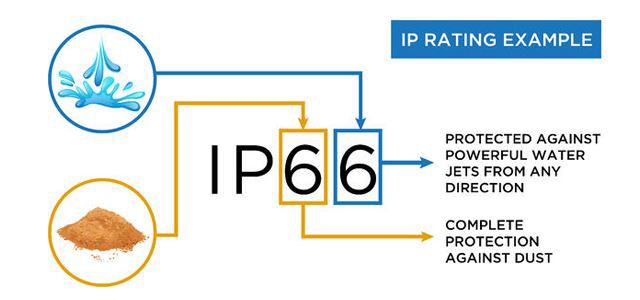
The characteristic numerals in an IP rating indicated conformity with conditions summarized in the table below. The first digit designates the level of protection that a particular enclosure has against hazardous parts and the ingress of solid foreign objects. The second digit designates the protection of equipment inside the enclosure against the ingress of water. For example, an LED luminaire that’s rated IP 65 is completely protected against the intrusion of dust but will become unsafe if it’s immersed in water completely.
FIRST DIGIT: SOLIDS
| LEVEL | OBJECT SIZE PROTEDTED AGAINST | EFFECTIVE AGAINST |
| 0 | Not Protected | No protection against contact and ingress of objects. |
| 1 | >50mm | Any large surface of the body, such as the back of the hand, but no protection against deliberate contact with a body part. |
| 2 | >12.5mm | Fingers or similar objects. |
| 3 | >2.5mm | Tools, thich wires, etc. |
| 4 | >1mm | Most wires, screws, etc. |
| 5 | Dust Protected | Ingress of dust is not entirely prevented, but it must not enter in sufficient quantity to interfere with the satisfactory operation of the equipment; complete protection against contact. |
| 6 | Dust Tight | No ingress of dust; complete protection against contact. |
SECOND DIGIT: LIQUID
| LEVEL | OBJECT SIZE PROTECTED AGAINST | EFFECTIVE AGAINST |
| 0 | Non protected | No level of protection from liquid. |
| 1 | Dripping water | Dripping water (vertically falling drops) shall have no harmful effect. |
| 2 | Dripping water when tilted up to 15° | Vertically dripping water shall have no harmful effect when the enclosure is titled at an angle up to 15° from its normal position. |
| 3 | Spraying water | Water falling as a spry at any angle up to 60° from the vertical shall have no harmful effect. |
| 4 | Splashing water | Water splashing against the enclosrue from any direction shall nafe no harmful effect. |
| 5 | Water jets | Water projected by a nozzle (6.3mm) against enclosure from any direction shall have no harmful effect. |
| 6 | Powerful water jets | Water projected in powerful jets (12.5mm) against enclosure from any direction shall have no harmful effect. |
| 7 | Immersion up to 1m | Ingress of water in harmful quantity shall not be possible when the enclosure is immersed in water under defined conditions of pressure and time (up to 1m of suvmersion). |
| 8 | Immersion beyong 1m | The equopment is suitable for continuous immersion in water under conditions which shall be specified by the manufacturer. Normally, this will mean that the equipment is hermetically sealed. However, with certain types of equipment, it can mean that water can enter but only in such a manner that it produces no harmful effects. |
3. There Can Be A Third Digit In An IP Rating
The letter K is specified in DIN 40050-9, and not in IEC 60529.
IP ratings with the letter “K” (IP69K typically) are most prominent with food processing industries or industries where a high level of hygiene and cleanliness is paramount. IP69K provides protection against dust, high temperature, chemicals, and high pressure water. Enclosures with this rating withstand a rigorous high pressure wash-down procedure. This particular water intrusion test involves placing the product on a turntable with a rotational speed of 5 ±1 revolutions per minute. The product is then sprayed at close range at a rate of approximately 4 gallons per minute with water pressure of between 1160-1450 psi, at a temperature of 176°F (80°C). The nozzle from which the water is sprayed is held between 4 and 6 inches from the product enclosure at a variety of angles.
An additional digit, often an additional letter, indicates other protections the enclosure has:
·D - Wire
·F - Oil Resistant
·H - High Voltage
·M - Device Moving During Water Test
·S - Device Standing Still During Water Test
·W - Weather Conditions
Understanding What IP Ratings Mean To You.
By understanding what IP ratings mean for a particular luminaries, you’ll be able to effectively design a lighting schedule that makes the most sense or make an educated buying decision for your property. Our trusted and experienced lighting experts can help you during the process! If you have questions about a particular luminaries or just need guidance about a project, reach out directly to us below.
Email: inquiry@toppolighting.com
Mobile: +86-755-8429-6668
Send Inquiry