


How to Determine the Right Wattage LED Flood Light for Your Space
Aug 16, 2025
Leave a message
Choosing the right wattage for a led flood light depends on how big the area is. It also depends on what you want the floodlight to do. You need to think about how bright you want it. Many people make mistakes by only looking at wattage. They do not know that led flood lights use much less energy. Led flood lights can use up to 90% less energy than old lights. For example, a 150 watt led flood light can take the place of a 400 watt metal halide. This saves energy and money. Picking the right outdoor flood light also stops too much light. It helps you not waste electricity.
Key Factors for LED Flood Light Selection
Area Size
How big the area is matters a lot when picking a floodlight. Bigger places need more light to reach everywhere. You should measure the space in square feet. This helps you know how much wattage you need. For example, a backyard at home might use a 100 watt floodlight for 500 to 800 square feet. In a business parking lot, 100 watts only lights up 200 to 300 square feet. This is because these places need to be brighter. Sports fields can use a 100 watt floodlight to light up 2,000 square feet if it is high up. The table below shows how much wattage you need for different sizes:
|
Area Size (sq ft) |
Recommended Wattage (W) |
|---|---|
|
Small (up to 300) |
10 - 30 |
|
Medium (300 - 600) |
50 - 100 |
|
Large (600 - 1,000) |
150 - 300 |
|
Extra-Large (over 1,000) |
300 - 1000+ |
When the area gets bigger, you need more wattage for good lighting.
Lighting Purpose
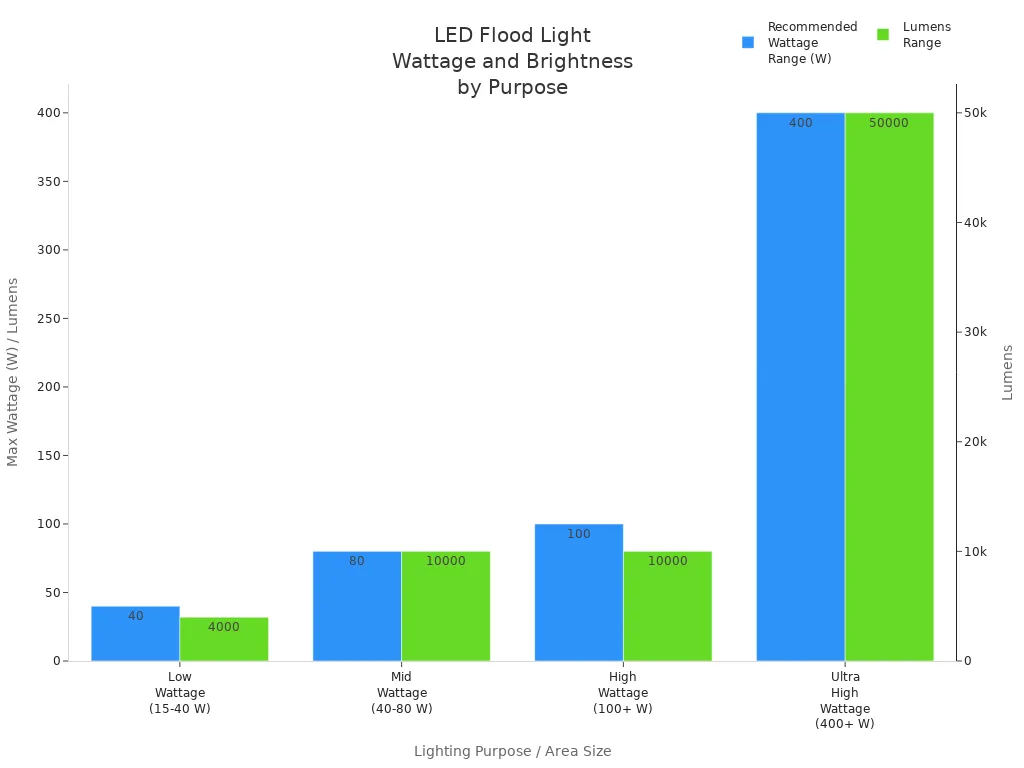
Why you need the floodlight changes how bright it should be. Security and task lighting need more wattage to make things bright and safe. This helps people see better and keeps places safe. Ambiance or accent lighting uses less wattage for a softer look. For example:
- Security and task lighting: Needs more wattage for bright, wide light.
- Ambiance and accent lighting: Uses less wattage for soft, gentle light.
- Entrance lighting: Needs medium wattage for safety and comfort.
- Task lighting: Needs bright floodlights for working.
The chart below shows how much wattage and lumens you need for different uses:
Desired Brightness
We measure brightness in lumens, not just watts. Lumens tell us how much light comes from the floodlight. Different jobs need different amounts of lumens. For example, path lights need 100 to 200 lumens. Floodlights for security need 700 to 1,300 lumens. Porch lights often use 800 to 1,000 lumens to make guests feel welcome. The table below gives more details about brightness for outdoor lights:
|
Outdoor Space |
Recommended Lumens |
Additional Notes |
|---|---|---|
|
Path lights |
100-200 lumens |
Put a light every 6-8 feet for safety |
|
Flood lights |
700-1300 lumens |
Bright for security and landscaping; point down |
|
Porch lights |
800-1000 lumens |
Bright enough for guests, you can use a dimmer |
Color temperature is important too. Warm light (2700-3000K) feels cozy and natural. Cool light (3500-4000K) is good for doing tasks.
Tip: Always look at both lumens and wattage when you pick a floodlight. Lumens and watts are not the same. LED floodlights use less power but can be just as bright. Lumens show how bright the light is. Wattage shows how much energy it uses. If you focus on lumens, you will get the right amount of light for your space.
Wattage Guide for LED Floodlights
Small Spaces
Small spaces like patios and walkways do not need much power. Using 10 to 30 watts is enough for these places. This wattage gives good light for seeing and makes the area feel nice. It does not make the light too bright or waste energy. Most people pick lower wattage floodlights for these spots. This helps make the space friendly and keeps it safe.
|
Space Type |
Recommended LED Flood Light Wattage |
Approximate Lumens Range |
Purpose/Notes |
|---|---|---|---|
|
Small spaces (patios, entryways, porches, walkways) |
10-30W |
1,000-3,000 lumens |
Provides enough light for seeing and ambiance without being too bright |
Lights work best when put below 10 feet in these areas. Lower lights help focus the beam and stop shadows. For example, a 15-watt floodlight on a porch can light up the door. This makes it safer at night. In gardens or along paths, a 20-watt floodlight can show off plants and help people find their way.
- Small spaces like gardens and entrances do well with low wattage LED floodlights.
- Adjustable mounts let you point the light where you want.
- Spotlights near doors help keep away intruders by making things easier to see.
Note: Pick lower wattages for cozy lighting. For security, use higher wattages to make the area brighter.
Medium Areas
Medium areas are places like driveways, backyards, and small parking lots. These spaces need more power to light up bigger areas. The best wattage for medium areas is between 30 and 80 watts. This gives enough light to keep things safe and easy to see.
|
Wattage Category |
Wattage Range (Watts) |
Typical Application Area |
|---|---|---|
|
Mid Wattage |
40 - 80 |
Medium-sized areas like small yards, gardens, or driveways |
A 50-watt floodlight can light up a backyard or driveway. This helps people see better at night. How high you put the light also matters. If you mount lights between 10 and 20 feet, you may need more power. This helps the light reach all parts of the area.
- Driveways and medium gardens often use 50-80 watt LED floodlights.
- Putting lights higher covers more space but may need more power.
For a backyard party, a 60-watt floodlight can give both safety and a nice look.
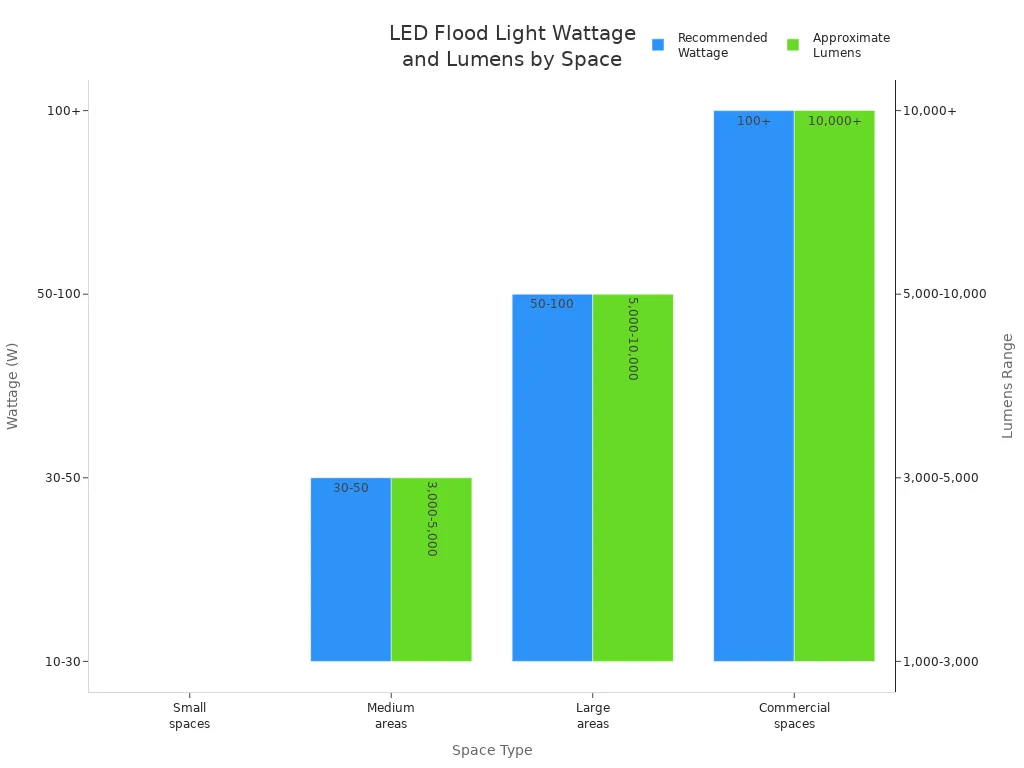
Tip: Always check how many lumens you need. For medium areas, try to get 3,000 to 5,000 lumens. This gives good brightness and saves energy.
Large Outdoor Floodlight Needs
Big outdoor spaces like parking lots and sports fields need strong floodlights. These places need high wattage to cover wide areas and give bright light. The best wattage starts at 100 watts and can go up to 1,000 watts or more for very big places.
|
Fixture Type |
Mounting Height (feet) |
Wattage Range (W) |
Typical Use |
|---|---|---|---|
|
LED Outdoor Stadium Floodlight |
30 – 100+ |
300 – 1000 |
Large outdoor sports fields |
|
LED Shoebox Fixture |
25 – 40 |
200 – 600 |
Practice fields, parking zones |
|
LED Modular Floodlight |
40 – 100+ |
400 – 1800+ |
Stadiums, high competition levels |
|
LED Asymmetric Floodlight |
30 – 60 |
300 – 1000 |
Perimeter poles, reduced glare |
When you put lights higher, the light must reach farther. For example, a 200-watt floodlight at 30 feet can light up a big parking lot. Sports fields often use many 400-watt or 600-watt floodlights. This helps light every part and keeps brightness even.
- A 10-watt LED floodlight lights up about 15-30 feet. This is good for small areas.
- A 50-watt floodlight lights up 50-75 feet. This works for medium spaces.
- A 200-watt floodlight lights up 100-150 feet. This is best for large outdoor needs.
|
Area Size |
Recommended Wattage Range |
|---|---|
|
Small Areas |
30-50W |
|
Medium Areas |
70-100W |
|
Large Areas |
150W and above |
|
Very Large Areas |
200W and above |
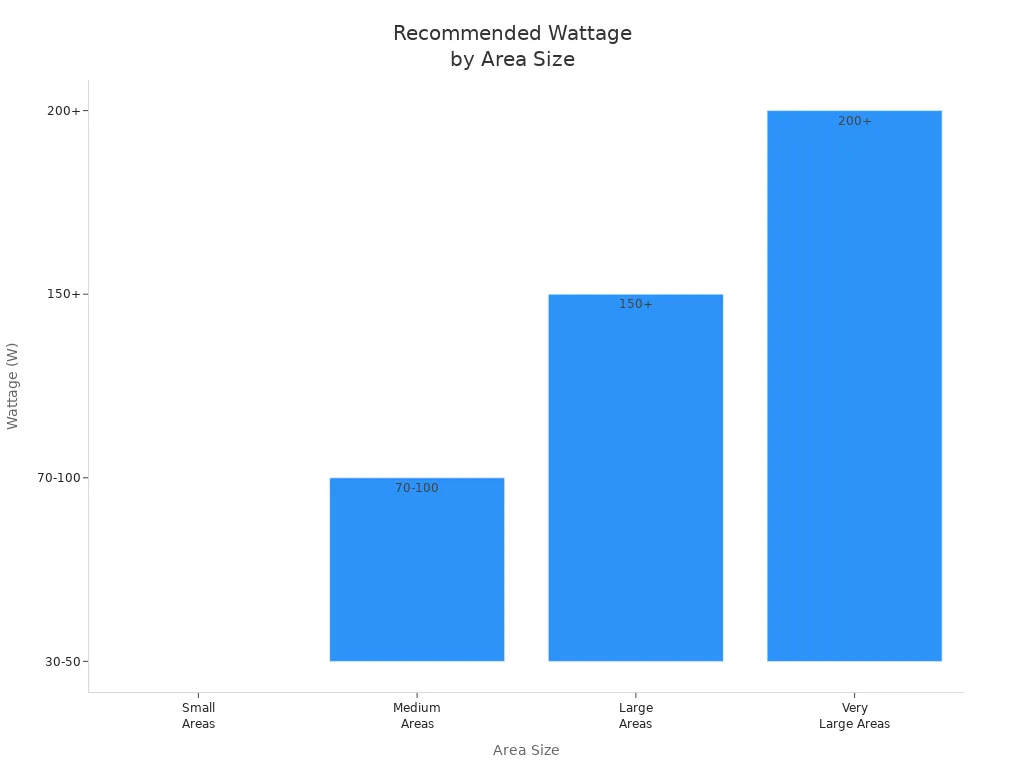
Remember: When you put lights higher or need to cover more space, use more wattage. This helps the light reach farther and stay bright. Always match the wattage to the size and use of the space for the best results.
Adjusting Your Outdoor Flood Light Setup
Mounting Height
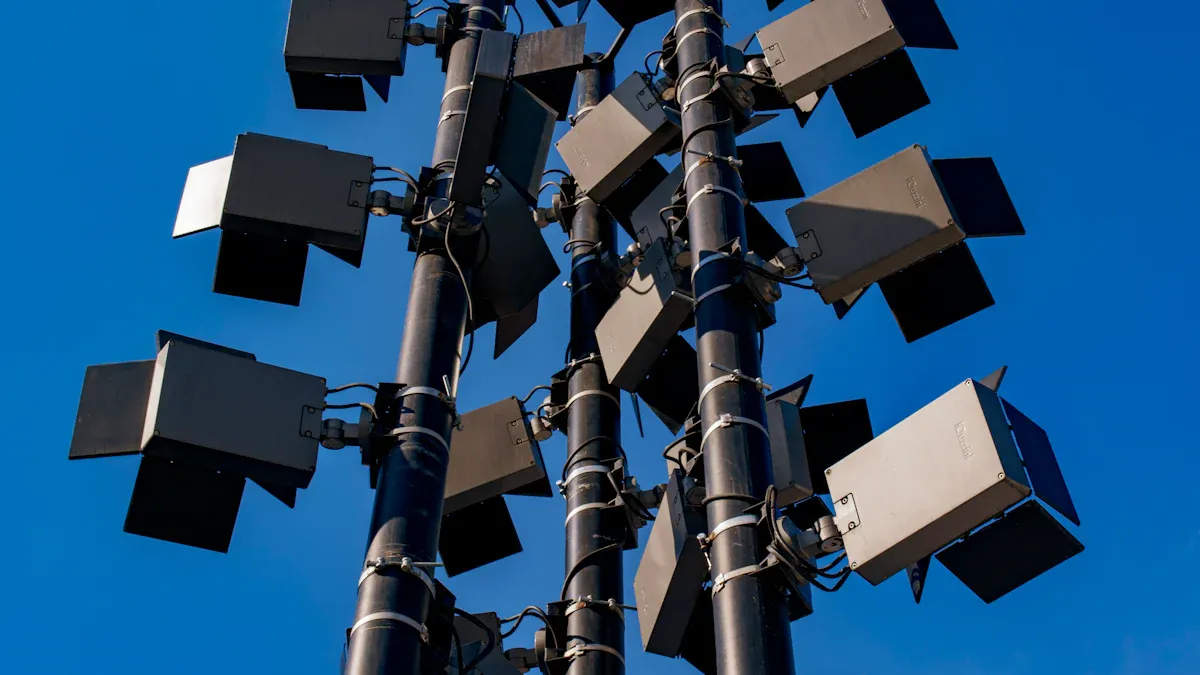
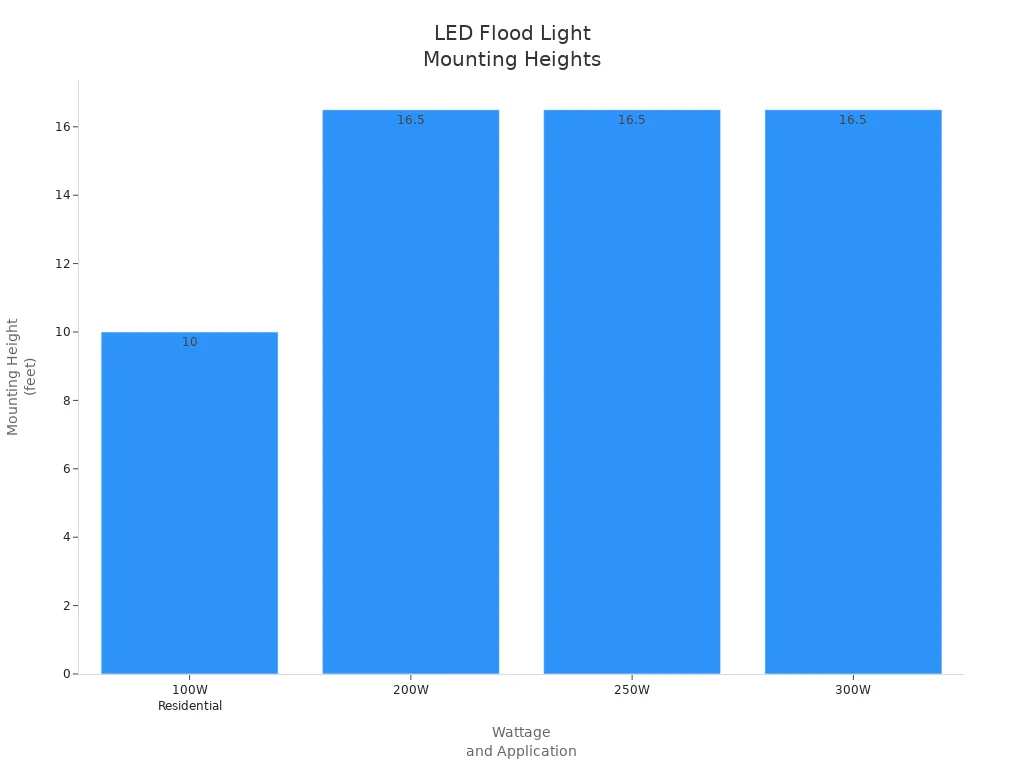
How high you put a floodlight is very important. If you put the light higher, it shines over a bigger area. This helps make fewer shadows and keeps places safer. When the light is lower, it shines in a smaller spot. This is good for patios or gardens. You should pick the right height for the wattage and the size of the space. For example, a 100-watt floodlight at 10 feet works well for a backyard. A 200-watt floodlight at 13 to 20 feet is better for big outdoor spaces. The right height helps the light be bright enough and cover the space you want.
|
Wattage |
Recommended Mounting Height |
Typical Application |
Coverage Area (sq ft) |
|---|---|---|---|
|
100W |
~10 feet |
Residential backyard |
500-800 |
|
200W |
13-20 feet |
Large outdoor areas |
1,500-2,000 |
Obstacles and Light Spread
Things like trees, bushes, walls, and buildings can block the light. Trees and plants can make the light look softer but may not light up everything. Walls and buildings can make dark spots or shadows. You should look for these things before picking where to put your floodlight. Sometimes you need a stronger light if something blocks it, but more power does not always fix the problem. You can also move the light or change its angle to help it shine better. Cleaning the light and checking wires helps keep it bright.
- Trees and bushes make the light softer in the area.
- Walls and buildings can block light and make shadows.
- Moving the light or changing its angle helps cover more space.
Avoiding Over-lighting
Too much light wastes energy and can make glare or bother others. Only use floodlights where you need them and point them down. Shields and good placement stop light from shining on streets or neighbors' yards. Timers and motion sensors help save energy by turning lights on only when needed. Warm-colored lights are better for animals and make the area feel nice. Dimmable LEDs let you change how bright the light is for different times.
Tip: Use just enough light for what you need. Good placement and controls keep outdoor spaces safe and comfortable without wasting energy.
LED Flood Light Tips and Efficiency
Energy Savings
LED flood lights help save energy and last a long time. They use much less electricity than old lights. The table below shows how they compare:
|
Feature |
Halogen Flood Lights |
LED Flood Lights |
|---|---|---|
|
Energy Consumption |
High energy usage |
Up to 80-90% less energy use |
|
Lifespan |
1,000–4,000 hours |
25,000–50,000+ hours |
A 500-watt halogen floodlight can be swapped for a 50-watt LED. Both give the same brightness, but the LED uses much less power. LEDs can last over 25,000 hours. Halogen bulbs only last a few thousand hours. This means you do not have to replace them as often. You also spend less money on repairs. Using LED flood lights outdoors is good for the planet. It makes less waste and lowers carbon emissions.
Motion Sensors
Motion sensors make outdoor floodlights use less energy. The lights turn on only when they sense movement. This saves power and helps lower your bills. Motion sensors also help keep places safe. They light up when someone comes close. Many outdoor flood lights now have smart features. These include timers and remote controls. You can set when the lights turn on or off. You can also change the brightness using your phone or a smart home device. Timers make sure lights are only on when needed. Remote controls make it easy to use the lights.
- Timers and settings help save energy.
- You can use apps to control lights from anywhere.
- Smart home systems let you automate your lights.
Tip: Motion sensors can save up to 80% more energy than lights that stay on all night.
Installation Safety
Installing flood lights the right way keeps them safe and working well. Here are some safety tips to follow:
- Use weatherproof materials and make sure wires are tight.
- Choose the best way to mount the light, like on a wall or pole.
- Point the floodlight so it does not shine where you do not want.
- Check the lights often for damage, dirt, or leaks.
- Test the lights to see if they flicker or get dim and fix problems fast.
- If the setup is big or tricky, ask a pro to help.
Clean and check your lights often to stop problems like flickering or water getting in. Make sure seals are tight and wires are safe. This helps your outdoor flood light last longer.
Picking the right wattage for a led flood light is easy if you follow some steps. First, look at how big your space is. Then, think about why you need the light. Use a guide to find the best wattage and brightness. Make changes for how high you put the light and if anything blocks it. Some lights have special features you can use. The table below lists what you should check:
|
Step |
What to Check |
|---|---|
|
Area Size |
Measure space for correct wattage |
|
Purpose |
Decide on security, ambiance, or tasks |
|
Brightness |
Select lumens for the right effect |
|
Installation |
Mount at proper height and location |
Putting the light in the right spot and keeping it clean saves energy. It also keeps your light working well. If your space is different or you have questions, look at the FAQ or talk to a lighting expert.
FAQ
How does wattage affect the brightness of an LED flood light?
Wattage shows how much energy the light uses. Lumens show how bright the light is. LED flood lights give more brightness per watt than old bulbs. Always check lumens for brightness, not just wattage.
Can one use multiple low-wattage flood lights instead of one high-wattage light?
Yes, using several low-wattage lights can cover a large area. This setup helps reduce shadows and gives even lighting. It also lets users control light direction better.
What is the best color temperature for outdoor LED flood lights?
Most people choose 3000K to 4000K for outdoor spaces. Warm white (3000K) feels cozy and natural. Cool white (4000K) works well for security and tasks. The right color temperature depends on the purpose.
Do LED flood lights work in cold or wet weather?
LED flood lights work well in cold and wet weather. Many models have weatherproof ratings like IP65. Always check the product label for outdoor use and weather resistance.
How can someone reduce glare and light pollution from flood lights?
Tip: Point flood lights downward and use shields. Choose the right wattage for the area. Install motion sensors or timers to limit use. This setup helps keep outdoor spaces safe and comfortable for everyone.
Send Inquiry