


2x4 led flat panel light
Nov 03, 2025
Leave a message
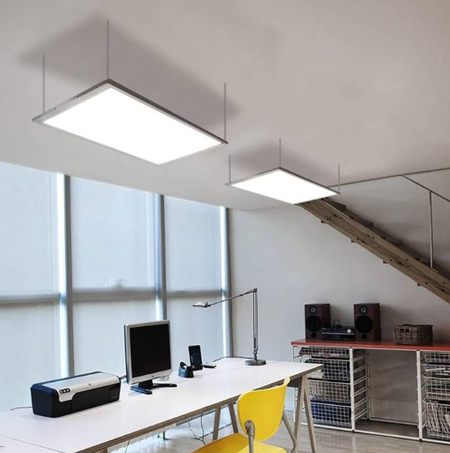
Can 2x4 LED Flat Panel Light Fit Offices?
Yes, the 2x4 led flat panel light fits standard office drop ceilings perfectly. These fixtures measure 2 feet by 4 feet and integrate seamlessly with 15/16-inch T-bar grid systems found in most commercial buildings, making them ideal replacements for traditional fluorescent troffers.
How 2x4 LED Flat Panel Light Systems Fit Standard Office Ceilings
Most commercial offices use suspended ceiling systems with standardized grid dimensions. The 2x4 measurement refers to the exact opening size in the ceiling grid-two feet wide by four feet long. This standardization emerged from decades of commercial construction practices and remains the dominant specification across North America.
The standard 15/16-inch grid system, commonly called the "1-inch wide grid," accommodates both 2x2 and 2x4 fixtures. When installing a 2x4 LED panel, the fixture drops directly into the grid opening and rests on the T-bar framework. Most panels include safety cables that attach to the ceiling structure above, providing additional security beyond the grid support.
The actual dimensions of 2x4 LED panels measure approximately 23.7 to 23.75 inches wide by 47.75 to 47.8 inches long. This slight reduction from a full 24x48 inches allows for proper fit within the grid channels while preventing binding or installation difficulties. The typical thickness ranges from 1.34 to 1.63 inches, making them suitable for most plenum spaces.
Why Offices Choose 2x4 LED Panels
Office lighting demands differ significantly from residential or industrial applications. Workers spend 8-12 hours daily under artificial lighting, making quality illumination critical for productivity and wellbeing.
Light Distribution Requirements
Offices require uniform illumination to prevent eye strain and support various tasks from computer work to document reading. The Illuminating Engineering Society recommends 40-50 lumens per square foot for general office areas. A typical 2x4 led flat panel light producing 5,000-7,000 lumens covers approximately 125-175 square feet at this specification.
Traditional fluorescent troffers with four T8 tubes consumed 80-120 watts while providing inconsistent light distribution. Dark spots often appeared between tubes, and light output degraded significantly over time. Edge-lit and backlit LED panels distribute light evenly across the entire 2x4 surface, eliminating shadowy areas and hotspots.
Energy Performance
The energy savings from LED panels justify their adoption in cost-conscious office environments. A fluorescent 2x4 troffer with four 32-watt T8 lamps draws approximately 128 watts including ballast losses. Comparable LED panels operate at 30-60 watts depending on output settings, representing 45-75% energy reduction.
For a 10,000 square foot office with 50 fixtures operating 12 hours daily at $0.13 per kWh, switching from fluorescent to LED panels saves approximately $3,000-4,500 annually. The cumulative savings over the panel's 50,000-hour lifespan (approximately 11 years at 12 hours daily) exceeds $35,000 before accounting for reduced maintenance costs.
Installation Simplicity
Retrofitting offices with a 2x4 led flat panel light system requires minimal electrical work when replacing existing fluorescent fixtures. Most installations take 30-55 minutes per fixture, including:
Disconnecting the old fixture's whip connector
Removing the fluorescent troffer
Dropping the LED panel into the grid opening
Connecting the whip to the LED driver
Securing the safety cable to ceiling structure
Contractors typically estimate one qualified electrician can install 8-10 fixtures during an 8-hour shift in standard office conditions. This fast turnaround minimizes disruption to business operations, allowing installations during off-hours or working around occupied spaces.
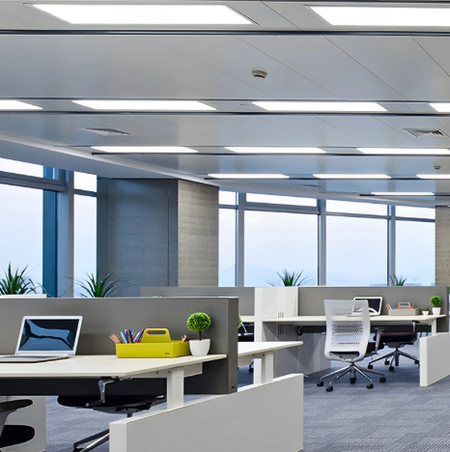
Selecting the Right 2x4 LED Flat Panel Light Specifications
Selecting appropriate 2x4 LED panels involves understanding specifications beyond basic compatibility.
Lumen Output and Efficacy
Modern 2x4 led flat panel light fixtures range from 3,500 to 9,000 lumens, with wattage ranging from 30W to 72W. The most efficient models achieve 125-140 lumens per watt. For standard office applications, 5,000-6,500 lumen panels provide adequate illumination without excessive brightness.
Efficacy matters because higher lumens-per-watt ratios deliver more light while consuming less energy. A panel producing 6,500 lumens at 50 watts (130 lm/W) outperforms one delivering 6,000 lumens at 60 watts (100 lm/W) in both operating cost and heat generation.
Color Temperature Selection
Color temperature, measured in Kelvin, dramatically affects office ambiance and worker comfort. The three standard options serve different purposes:
3000K (Warm White): Creates relaxed atmosphere suitable for break rooms and reception areas
4000K (Neutral White): Balances warmth and brightness for general office spaces
5000K (Daylight): Provides cool, crisp light ideal for detailed work and conference rooms
Research from the National Renewable Energy Laboratory found offices maintaining 4000-5000K color temperatures reported 3-5% productivity increases compared to spaces with inconsistent or poorly chosen lighting. Many modern panels include selectable color temperature switches, allowing adjustment between 3000K, 4000K, and 5000K without replacing fixtures.
Color Rendering Index
CRI measures how accurately light reveals true colors, with natural daylight scoring 100. Office environments benefit from CRI ratings above 80, ensuring documents, computer screens, and faces appear natural. Most quality 2x4 LED panels achieve CRI 80-85, sufficient for standard office applications.
Specialized applications like graphic design studios or medical offices may require CRI 90+ for color-critical work. These premium panels cost 15-25% more but deliver superior color fidelity.
Dimming Capabilities
Dimmable 2x4 LED panels require 0-10V dimming switches for control. This low-voltage dimming system allows smooth adjustment from 10-100% brightness without flicker or hum. Dimming serves multiple purposes:
Reducing light levels during presentations
Adjusting brightness based on natural daylight availability
Decreasing energy consumption during low-activity periods
Meeting occupant comfort preferences
Facilities utilizing daylight harvesting-automatically dimming artificial lights as natural light increases-can reduce lighting energy consumption by an additional 20-30% in perimeter zones with windows.
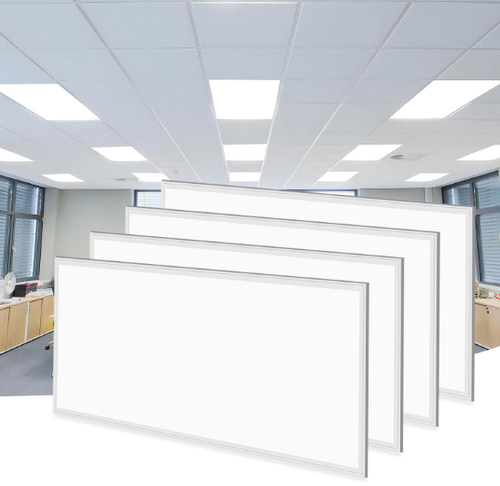
Installation Methods for Different Office Layouts
While drop ceiling integration is standard, alternative mounting methods accommodate various architectural situations.
Recessed Drop Ceiling Installation
The most common method involves dropping panels directly into T-bar grid openings. The panel rests on the grid flanges with its front surface flush with ceiling tiles. Installation requires:
Shutting off power at the circuit breaker
Removing existing ceiling tile or fixture
Identifying the electrical whip above the ceiling
Positioning the LED panel in the grid opening
Connecting the whip to the panel's driver
Securing the safety cable to structural support
Restoring power and testing
This method works for 90% of office retrofit projects where standard suspended ceilings exist.
Surface Mount Application
Offices with hard ceilings (drywall or plaster) require surface mount frames. These thin aluminum frames attach to the ceiling with screws, raising the panel approximately 1 inch from the surface. Surface mounting suits:
Modern offices with exposed structure aesthetics
Spaces with insufficient plenum depth for recessed installation
Renovations where existing ceiling remains in place
Surface mount installation takes slightly longer (45-70 minutes per fixture) due to positioning, drilling, and anchoring requirements.
Suspended/Pendant Installation
Some contemporary offices feature pendant-hung lighting for architectural interest. Pendant mount kits suspend 2x4 panels via cables or stems from the structural ceiling. This method provides:
Adjustable height for different ceiling configurations
Distinctive visual impact in reception or collaboration areas
Flexibility in open-plan spaces without traditional ceilings
2x4 LED Flat Panel Light Maintenance and Longevity
LED panels drastically reduce maintenance burden compared to fluorescent systems.
Lifespan Comparison
Quality 2x4 led flat panel light fixtures are rated for 50,000-100,000 hours of operation. At 12 hours daily (typical office usage), this translates to:
50,000 hours = 11.4 years
100,000 hours = 22.8 years
Fluorescent lamps require replacement every 10,000-20,000 hours (2-4.5 years), with ballasts failing after 40,000-60,000 hours. Over a 20-year period, fluorescent systems need 4-6 lamp replacements and 1-2 ballast replacements per fixture. LED panels require zero replacements during the same timeframe.
Lumen Maintenance
LED panels maintain brightness better than fluorescent systems. Quality LEDs retain 90% of initial output at 50,000 hours (L90), compared to fluorescents that degrade to 70-80% within 10,000 hours. This consistent output eliminates the gradual dimming that characterizes aging fluorescent installations.
Failure Modes
When fluorescent lamps fail, they flicker, darken at ends, or stop completely-creating immediate noticeable problems. LED panels rarely fail suddenly. Instead, they gradually dim over decades. Driver failure (the most common LED panel issue) typically occurs after 40,000-60,000 hours and can be replaced without changing the entire fixture in many designs.
Cost Analysis for Office Implementation
Understanding total cost of ownership guides informed purchasing decisions.
Initial Investment
Quality 2x4 LED panels range from $45-120 per fixture depending on features:
Basic models ($45-65): Fixed wattage/CCT, standard efficacy (100-110 lm/W)
Mid-tier models ($70-95): Selectable wattage/CCT, high efficacy (120-130 lm/W), dimming
Premium models ($100-120): Maximum efficacy (135+ lm/W), high CRI (90+), advanced controls
Labor costs for installation typically run $40-80 per fixture, varying by region, ceiling height, and existing conditions.
Operating Costs
Comparing a 50-fixture office over 10 years (operating 12 hours daily, 260 days annually):
Fluorescent System (80W per fixture):
Annual energy: 12,480 kWh
Annual cost at $0.13/kWh: $1,622
10-year energy cost: $16,220
Lamp replacements (4x): $4,500
Ballast replacements (1x): $3,000
Total 10-year cost: $23,720
LED System (50W per fixture):
Annual energy: 7,800 kWh
Annual cost at $0.13/kWh: $1,014
10-year energy cost: $10,140
Replacements: $0
Total 10-year cost: $10,140
Net savings: $13,580 over 10 years, plus eliminated disruption from maintenance events.
Utility Rebates
Many utility companies offer rebates for LED retrofits. The Design Lights Consortium (DLC) certification qualifies fixtures for rebates ranging from $15-40 per fixture. On a 50-fixture project, rebates can reduce initial costs by $750-2,000, improving payback periods from 2-3 years to 1.5-2 years.
Addressing Common Office Lighting Challenges
2x4 LED panels solve several persistent problems in office environments.
Flicker Elimination
Fluorescent fixtures flicker at 120Hz (twice the AC frequency), causing eye strain, headaches, and reduced concentration. While often imperceptible consciously, this flicker measurably affects some individuals. Quality LED drivers provide flicker-free operation, eliminating this invisible stressor.
Instant Start
Fluorescent lamps require warm-up time, producing reduced light output for 30-60 seconds after switching on. LED panels reach full brightness instantaneously, eliminating dark periods when entering spaces or restoring power after outages.
Temperature Tolerance
Fluorescent lamps lose efficiency and lifespan in cold environments, problematic for offices with aggressive air conditioning. LED panels operate efficiently across -4°F to 104°F (-20°C to 40°C), maintaining consistent performance regardless of HVAC settings.
Reduced Heat Output
Fluorescent fixtures waste approximately 70% of energy as heat, contributing to cooling loads. LED panels convert 85-90% of energy to light, generating minimal heat. In air-conditioned offices, this reduction decreases cooling costs by 3-5% in lighting-dense areas.
Integration with Modern Office Systems
Contemporary 2x4 LED panels accommodate advanced control systems.
Occupancy Sensing
Panels with built-in sensor receptacles or external motion sensors automatically dim or shut off when spaces remain unoccupied. In conference rooms, break areas, and private offices, occupancy-based controls reduce energy consumption by 20-35% compared to manual switching.
Daylight Harvesting
Photosensor-equipped systems automatically dim artificial lighting as natural daylight increases through windows. Perimeter zones with adequate fenestration can achieve 25-40% additional energy savings during daylight hours.
Networked Lighting Controls
Advanced LED panels integrate with building management systems via wireless protocols or wired networks. These smart systems enable:
Individual fixture scheduling and dimming
Space utilization analytics based on lighting patterns
Predictive maintenance alerts before failures occur
Energy dashboards showing real-time consumption
Environmental Impact
LED adoption delivers measurable environmental benefits.
Mercury Elimination
Each fluorescent lamp contains 3-5mg of mercury. A 50-fixture office replacing lamps every 3 years disposes of approximately 200 lamps over 20 years-nearly 1 gram of mercury. LED panels contain no mercury, eliminating this toxic waste stream.
Carbon Footprint Reduction
The 45-75% energy savings from LED panels directly reduces carbon emissions. Using the U.S. average of 0.92 pounds CO₂ per kWh, a 50-fixture office switching from fluorescent to LED prevents approximately 4,300 pounds (2.15 tons) of CO₂ emissions annually-equivalent to planting 100 trees or removing one car from roads.
Reduced Waste Generation
Over 20 years, fluorescent systems generate substantial waste:
200-300 failed lamps
50-75 failed ballasts
Packaging materials from repeated purchases
LED systems generate zero lamp waste during the same period, with only eventual fixture disposal at end-of-life.
Frequently Asked Questions
Can 2x4 LED panels replace any fluorescent troffer?
Yes, 2x4 LED panels replace any fluorescent troffer fitting standard grid openings. The electrical connection reuses the existing whip, eliminating rewiring. However, verify plenum depth exceeds 3-4 inches to accommodate the panel's driver housing.
Do LED panels work with existing fluorescent dimmer switches?
No, fluorescent dimmers are incompatible with LED panels. LED panels require 0-10V dimming systems specifically designed for LED technology. Attempting to use fluorescent dimmers causes flickering, buzzing, and potential driver damage. Upgrade to compatible 0-10V dimmers when retrofitting.
How many 2x4 LED panels does a typical office need?
Calculate based on 40-50 lumens per square foot for general office work. A 5,500-lumen panel covers approximately 110-140 square feet. For a 2,000 square foot office, install 14-18 panels for adequate coverage. Adjust for natural light availability and specific task requirements.
What happens if one LED panel fails?
Unlike fluorescent banks where one failed lamp darkens an entire area, LED panel failure affects only that single fixture. Quality panels rarely fail suddenly-they gradually dim over years. Most failures involve the driver, which can be replaced independently in many models without replacing the entire panel.
The 2x4 led flat panel light represents a mature, proven technology perfectly suited for office environments. The combination of standardized sizing, superior light quality, dramatic energy savings, and minimal maintenance creates a compelling case for adoption. Installation simplicity and rapid payback periods remove traditional barriers to LED upgrades.
For offices still operating fluorescent systems, the transition to 2x4 led flat panel light fixtures offers immediate operational benefits-lower utility bills, reduced maintenance calls, better light quality-while supporting broader sustainability goals. The standardized form factor ensures fixture availability, competitive pricing, and contractor familiarity for decades to come.
Data Sources
Illuminating Engineering Society (IES) - Office lighting standards and footcandle recommendations
National Renewable Energy Laboratory - Office lighting productivity research, 2024
Design Lights Consortium (DLC) - LED panel certification standards and efficacy data
U.S. Department of Energy - LED lifespan and energy efficiency data, 2024-2025
Commercial LED manufacturers - Technical specifications for 2x4 panels (1000Bulbs.com, LEDMyPlace, Commercial LED Lights)
Energy cost calculations based on U.S. Energy Information Administration commercial rates
Send Inquiry